 English
 Deutsch
 Español
 Français
 Italiano
 Nederlands
 العربية
 中文
 Dansk
 Svenska
 Norsk
 Suomi
 日本語
 Polski
 Português

Paediatric motor assessment & tracking
You see the curve, not just reassurance.
Paediatric motor assessment at our centre in Zug means we assess at the start, track every day, and report at the end — with recognised tools, in plain English. Measurable progress you can show your doctors and your insurer.
Proof, not promises
The ORCA report.
ORCA in five minutes — a short walkthrough of everything you need to know.
How the report works
What you take home.
In the end, every block ends with a report that shows where your child started, what we worked on and what changed, measured against the goals we set together on day one.
The scores (GMFM, Peabody-3, ICF-CY) are explained in plain words, with photos and short videos of the milestones, and the report closes with your take-home program. You can hand it to your doctors and insurer as it is, and you’ll always find it in the family portal.
In plain English
What the metrics mean.
GMFM-88
Gross Motor Function Measure. A standardised test of how well your child performs gross-motor tasks: lying and rolling, sitting, crawling and kneeling, standing, walking, running and jumping. Each of the 88 tasks is scored from 0 to 3, and we report the result with a 95% confidence interval, so you can see whether a change is bigger than normal day-to-day variation.
Peabody-3 (PDMS-3)
Peabody Developmental Motor Scales. Measures fine and gross motor development against age norms — useful for early intervention and developmental delay.
ICF-CY
International Classification of Functioning — Children & Youth. A whole-picture framework — not just the body, but activity and participation in everyday life.
GMFCS level
Gross Motor Function Classification System. Five levels (I to V) that describe how a child with cerebral palsy usually moves in everyday life, at home and at school, not their best moment in therapy. It is a description, not a grade, and it lets us compare your child’s GMFM result with children at the same level on international reference curves.
The data journey
From day one to final report.
-
Day 1
Pre-assessment
A full baseline with GMFM, Peabody-3 and ICF-CY — where your child is today.
-
Daily
Micro-tracking
Small measurements logged every session, so nothing meaningful is missed.
-
Day 20
Post-assessment
We re-test with the same tools — and you see exactly what changed.
-
After
Final ORCA report
A clear, shareable summary for you, your doctors and your insurer.


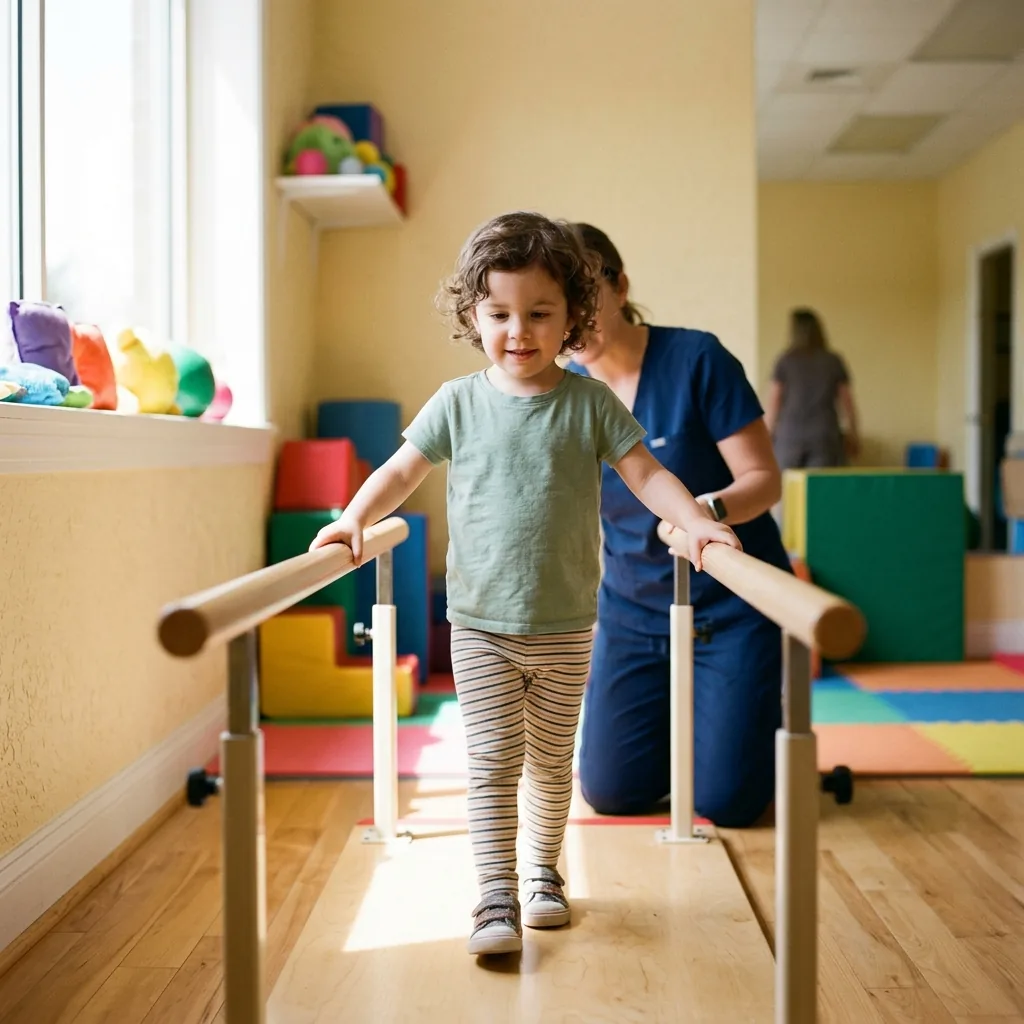

Why data matters.
Objective paediatric motor assessment keeps us accountable, shows you real progress — and makes a far stronger case for insurance and funding approvals.
Parents ask
Quick answers for parents.
What’s in the ORCA report?
Six short parts: your child’s story and starting point; our findings, area by area; the scores (GMFM with its confidence interval and GMFCS percentile, plus Peabody-3 where it fits the age); goals for the next 3 to 6 months; our recommendations for therapy, aids and other specialists; and your take-home program.
Which reports will we get?
An assessment report at the start, an end-of-intensive report after each block and progress reports in between, plus an enablement report on what you have learned to do at home. When you need funding, we add focused recommendations for your doctor or insurer, for example for aids, TheraTogs or DMI.
Which tests will my child have?
Usually the GMFM and, up to 5 years 11 months, the Peabody-3, placed within the ICF-CY. In each case, we choose what fits your child’s age and condition and explain why in the report.
How are the goals set?
Together with you on day one. What matters most to your family becomes concrete goals for the next 3 to 6 months, and the report shows whether they were reached.
How do I know the progress is real?
We re-test with the same tools under the same conditions and show the GMFM with its confidence interval: if the ranges no longer overlap, the change is very likely real. The percentile compares your child only with children of the same age and GMFCS level.
My child’s score went down. Did therapy fail?
Not necessarily. Illness, tiredness or a growth spurt can lower a score on the day. We look at the trend with you, not at one number.
Can I share the report, and in which language?
Yes. It is written so your doctors and insurer can read it as it is, in several languages including German, English, French, Italian, Spanish, Dutch and Portuguese. All reports are in the family portal at fam.apexaqla.ch.