English
 Deutsch
 Español
 Français
 Italiano
 Nederlands
 العربية
 中文
 Dansk
 Svenska
 Norsk
 Suomi
 日本語
 Polski
 Português

Films & series
Films and series about rare and genetic conditions: 10 picks for families, with a therapist’s view
From Wonder and The Peanut Butter Falcon to Lorenzo’s Oil and Born This Way — the best films and series about rare and genetic conditions, what each one shows honestly, which ones star people who have the condition themselves, and which to watch with your children.
When your child has a rare or genetic diagnosis, it can feel as if nobody else has heard of it — least of all film-makers. Yet some of the most loved films of the last forty years are about exactly these conditions. Below are our ten picks, chosen by our team at Apexa QLA Suisse for honesty, warmth and what they can give families. For each, we say what it shows well and who it is for. This is the second list in our series — our first covers films about cerebral palsy.
Our 10 picks at a glance
- Wonder (2017, film) — best for families with children
- Born This Way (2015–2019, docuseries) — best documentary series
- The Peanut Butter Falcon (2019, film) — best adventure
- Champions / Campeones (2018, film) — best comedy
- Gabrielle (2013, film) — best about independence and love
- Lorenzo’s Oil (1992, film) — the classic about parents and research
- Extraordinary Measures (2010, film) — best about a father’s fight for treatment
- Mask (1985, film) — best about a mother and son
- Five Feet Apart (2019, film) — for teenagers, with caveats
- The Elephant Man (1980, film) — for parents, a historical view
Why it matters who plays the role
For decades, characters with a rare or genetic condition were mostly played by actors without it, sometimes in prosthetic make-up — and many of those performances are wonderful. Acting is a craft: a gifted actor who researches a condition carefully and listens to the people who live with it can play the role with real truth and warmth. It works the other way round too — Michael J. Fox, who lives with Parkinson’s, has kept acting for decades in all kinds of roles. In the end, a film is a story and an experience, and what counts is that it is told with honesty and respect. More and more films now also cast people who have the condition themselves: Gabrielle Marion-Rivard, who has Williams syndrome, plays the lead in Gabrielle; Zack Gottsagen, who has Down syndrome, stars in The Peanut Butter Falcon; the team in Campeones is played by actors with intellectual disabilities; and the young adults in Born This Way are simply themselves. Whoever plays the role, these films can inspire: they open eyes, start conversations at home and give children who look or move differently a hero to cheer for. We mark the titles with actors who share the condition below.
1. Wonder (2017)
Film · family viewing · from about 8 years
Auggie Pullman was born with Treacher Collins syndrome, a rare genetic condition that affects how the face and skull develop. After years of home schooling and many operations, he starts at a mainstream school — and everyone, from his classmates to his older sister, has to work out how to treat him. Based on R. J. Palacio’s novel, with Julia Roberts and Owen Wilson as his parents. It was nominated for the Academy Award for Best Makeup and Hairstyling.
Our view: the easiest way into a conversation about difference for primary-school children, and especially good on siblings: Auggie’s sister Via gets her own part of the story. Be aware of the criticism: Auggie is played by Jacob Tremblay, who does not have the condition, in prosthetic make-up — although the author reportedly pushed for a child with Treacher Collins syndrome to be cast — and some people with facial differences felt the film makes life look easier than it is.
2. Born This Way (2015–2019)
Documentary series · A&E · four seasons · from about 12 years · cast with the condition
This reality series follows seven young adults with Down syndrome in the Los Angeles area as they work, study, date, move out and argue with their parents about it. It won the Primetime Emmy for Outstanding Unstructured Reality Program in 2016.
Our view: nothing scripted, nobody acting — just young people with Down syndrome talking about their own lives and plans. For parents of a young child it is a hopeful look at the years ahead. Some episodes deal with relationships, so watch with younger viewers.
3. The Peanut Butter Falcon (2019)
Film · from about 12 years · actor with the condition
Zak, a young man with Down syndrome, has been placed in a home for older people. He escapes to chase his dream of becoming a wrestler and teams up with a troubled fisherman, played by Shia LaBeouf. Zack Gottsagen, who has Down syndrome, met the writer-directors at an acting camp for people with disabilities and told them he wanted to be a film star — so they wrote the film for him. In 2020 he became the first person with Down syndrome to present an award at the Oscars.
Our view: a warm, funny adventure that treats Zak as a full person with his own dreams and stubbornness, and is sharp about how institutions limit adults with disabilities “for their own safety”. Some strong language, drinking and danger, so it suits teenagers and adults.
4. Champions / Campeones (2018)
Film · Spain · from about 10 years · cast with intellectual disabilities
A bad-tempered professional basketball coach is sentenced to community service: coaching a team of players with intellectual disabilities, two of whom have Down syndrome. Javier Fesser’s comedy is loosely inspired by a real team near Valencia and was cast with actors with intellectual disabilities, most of them first-timers. It won the Goya Award for Best Film, and Jesús Vidal won Best New Actor. An American remake, Champions (2023) with Woody Harrelson, also cast actors with intellectual disabilities.
Our view: genuinely funny, and the jokes are mostly on the coach, not the team. In Spanish, so with subtitles — or choose the English remake, which most critics found more formulaic.
5. Gabrielle (2013)
Film · Canada (French) · for older teenagers and adults · actress with the condition
Gabrielle, a young woman with Williams syndrome, sings in a choir of adults with disabilities in Montreal. She falls in love with a fellow choir member, and both want more independence than their families think they can handle. Gabrielle Marion-Rivard, who has Williams syndrome herself, won Best Actress at the Canadian Screen Awards.
Our view: one of the very few films about a rare syndrome told from the inside, full of musical joy. It deals openly with love and sexuality in adults with intellectual disabilities — a subject many parents worry about privately — so it is for older viewers.
6. Lorenzo’s Oil (1992)
Film · true story · for older teenagers and adults
Augusto and Michaela Odone’s young son Lorenzo is diagnosed with adrenoleukodystrophy (ALD), a rare genetic disease of the nervous system. Told there is nothing to be done, they teach themselves biochemistry and push researchers to look for a treatment. Directed by George Miller, with Nick Nolte and Susan Sarandon, who was nominated for the Oscar for Best Actress.
Our view: almost every parent of a child with a rare disease recognises the Odones — the late nights reading research, the fights with experts, the strain on a marriage. But it has been criticised for suggesting a miracle cure; later research has not clearly shown that the oil helps once ALD has started, and a scientist portrayed in it strongly objected. It also shows a child’s decline very directly.
7. Extraordinary Measures (2010)
Film · based on a true story · from about 12 years
John Crowley, played by Brendan Fraser, has two children with Pompe disease, a rare genetic condition that weakens the muscles, including the heart and breathing muscles. He leaves his job to start a biotech company with a difficult scientist, played by Harrison Ford, to develop a treatment. Based on Geeta Anand’s book The Cure.
Our view: a hopeful drama about the business side of rare-disease research — funding, investors and how slowly medicine moves. Good to know: the children are older than in real life, and Ford’s scientist is fictional. Watch it as a story about a parent’s determination, not a documentary.
8. Mask (1985)
Film · true story · from about 13 years
Rocky Dennis is a teenager with craniodiaphyseal dysplasia, a very rare genetic condition that causes extra bone growth in the skull and face. He is clever, funny and popular, and his mother, played by Cher, refuses to let anyone treat him as less. Eric Stoltz plays Rocky. Cher won Best Actress at Cannes, and the film won the Academy Award for Best Makeup.
Our view: a loving portrait of a mother and son who meet the world head-on, with Rocky’s friendships and first love shown tenderly. As with Wonder, the lead is played by an actor without the condition, in prosthetic make-up. His mother’s life includes drugs and a biker crowd, so it is for teenagers and adults.
9. Five Feet Apart (2019)
Film · teen romance · from about 13 years
Two teenagers with cystic fibrosis, a genetic condition that mainly affects the lungs, meet in hospital and fall in love — but must keep their distance to avoid passing infections to each other. With Haley Lu Richardson and Cole Sprouse. Claire Wineland, a young advocate with cystic fibrosis, worked on it as a consultant.
Our view: it gets daily treatment routines and long hospital stays right. But it is a romance first, and people with cystic fibrosis criticised it for making risky behaviour look romantic and for using a serious illness as a plot device; the Cystic Fibrosis Foundation, on the other hand, welcomed the attention. Watch it together and talk afterwards.
10. The Elephant Man (1980)
Film · black and white · for older teenagers and adults · historical
David Lynch’s film tells the story of Joseph Merrick (called John in the film), a man in Victorian London exhibited in a freak show because of severe overgrowth of his skin and bones, until a surgeon, played by Anthony Hopkins, brings him to the London Hospital. John Hurt plays Merrick, and the film received eight Academy Award nominations. Merrick is now thought to have had Proteus syndrome, a very rare overgrowth condition, although this has never been proven.
Our view: not for children, and hard to watch in places. We include it as a reminder of how people with visible differences were once treated.
What these films can mean for parents
Films about rare and genetic conditions can be comforting, painful and inspiring at the same time. Many parents tell us they cried at scenes that felt like their own life: the doctor who has never heard of the diagnosis, the first day at a new school. A few things are worth keeping in mind:
- Every child is different — even with the same diagnosis. Genetic conditions vary hugely. A film shows one person, not your child.
- Hollywood likes miracle cures. Real progress in rare diseases is slower and usually comes from many small steps — in research and in everyday therapy.
- Low expectations are the real enemy. Almost every story here is about someone who was underestimated. That message is worth sharing with teachers, relatives and classmates.
- Watch together. For children with a rare condition and their siblings, a good film is an easy way to start conversations about feelings and being different.
How we work with children with rare and genetic conditions
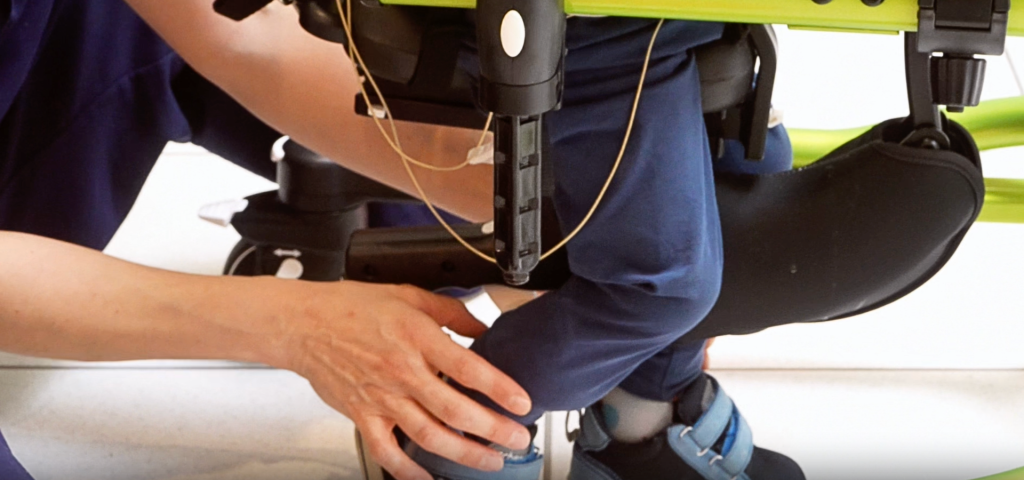
At Apexa QLA Suisse in Zug we work every day with children with rare and genetic syndromes, often with complex motor delay — and complex cases are our focus. We use modern, active rehabilitation rather than passive treatment:
- every plan is built with the ORCA Method (Objective Reasoning & Clinical Architecture), created by our lead therapist Fabienne Theler, MSc PT, so each goal follows from the child’s own findings rather than the label of the syndrome;
- DMI uses neuroplasticity — the brain’s ability to form and strengthen connections through active, repeated practice — and, with suit therapy and the Spidercage, builds head and trunk control, balance, standing and walking;
- TheraTogs support alignment through the day — we are the TheraTogs experts: our certified fitters are recognised worldwide and were trained by the inventor of TheraTogs, Beverly (Billy) Cusick;
- we measure progress with the GMFM and Peabody-3 and set goals with the ICF-CY, including participation at school and at home;
- ORCA Intensives of one to four weeks, parent enablement so progress continues at home, and — if you wish — medical case management.
Read our guide to genetic syndromes and motor delay and our overview of how we treat genetic syndromes.
Questions parents often ask
What is the best film for children about a genetic condition?
For children from about eight years, we recommend Wonder. For older children who love sport, Campeones is a great family comedy.
Which films star actors who have the condition themselves?
Gabrielle (Gabrielle Marion-Rivard, Williams syndrome), The Peanut Butter Falcon (Zack Gottsagen, Down syndrome), Campeones and its remake Champions (casts with intellectual disabilities) and the docuseries Born This Way (young adults with Down syndrome).
Which films are based on true stories?
Lorenzo’s Oil, Extraordinary Measures, Mask and The Elephant Man, although each changes details for the screen. Wonder and Five Feet Apart are fiction.
Are there films about SMA, Rett syndrome or Angelman syndrome?
Not yet a major feature film that we can recommend. There are smaller, family-made documentaries — for example Magnolia’s Hope, about a girl with Rett syndrome, whose proceeds support Rett research — and short films shown at rare-disease film festivals. Patient organisations are often the best place to find them.
Where do I start explaining a rare diagnosis to siblings?
Start simply and honestly, with words that fit their age: what the condition means for daily life, that it is nobody’s fault, and that they can ask anything. A film like Wonder, where the sister has her own story, can open the conversation. Ask afterwards which character they felt most like.
Is it a problem when an actor without the condition plays the role?
Not in itself. Acting means stepping into someone else’s life, and a well-researched performance can be moving and true. Some people with disabilities would like to see more of these roles go to actors who share the condition, and we think both have their place. We include films of both kinds because they tell important stories well — choose what feels right for your family.
My child’s condition is so rare that there is no film about it. What then?
That is true for most families we meet. Films about other conditions often still fit: being underestimated and finding the right team are similar across diagnoses.
Can I suggest a film for this list?
Please do. We update our film lists regularly — send us your favourites through our contact page.
Next step: talk to us
If your child has a rare or genetic condition and you would like to know how modern rehabilitation could help, book a free introductory call. Families travel from all over the world to Zug for modern therapies and the latest advances in paediatric rehabilitation.
Film selection and reviews by the Apexa QLA Suisse team. Clinical content on this website is reviewed by Fabienne Theler, MSc PT.