English
 Deutsch
 Español
 Français
 Italiano
 Nederlands
 العربية
 中文
 Dansk
 Svenska
 Norsk
 Suomi
 日本語
 Polski
 Português

Therapy explained
DMI therapy explained: roots in CME, how we use it in ORCA — and why exercises alone are not enough
Dynamic Movement Intervention is a clever series of exercises — but a tool is only as good as the clinical reasoning and the team around it. A therapist’s guide for parents.
“Can DMI help my child sit, stand or walk?” It is one of the first questions families ask us, often after finding videos of DMI — Dynamic Movement Intervention — online. To be honest, the answer is: DMI therapy can be a powerful tool — in the right hands, for the right child, at the right time, as part of a bigger plan. On its own, however, it is a series of exercises. What turns those exercises into progress is the therapist who chooses them, the team that surrounds your child and the measurements that show whether it is working.
In this guide, we explain what Dynamic Movement Intervention is, where it comes from — including its roots in CME (Cuevas Medek Exercises) — how we integrate DMI into the ORCA Method, what the research does and does not show, and the DMI questions parents ask us most. If you are looking for the short practical answers (session length, crying, orthoses, costs), our parent FAQ covers those.
What is Dynamic Movement Intervention (DMI) therapy?
Dynamic Movement Intervention in plain words
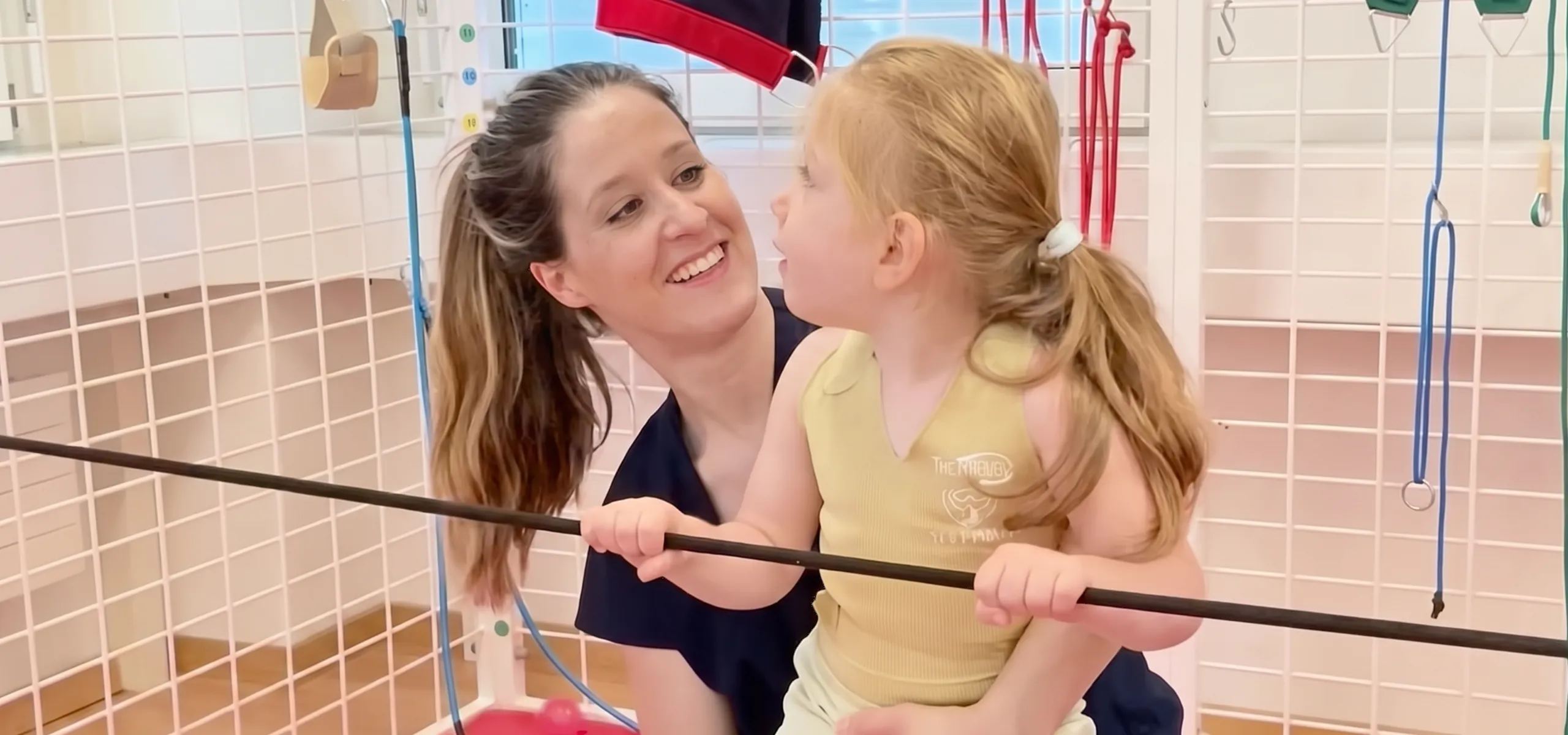
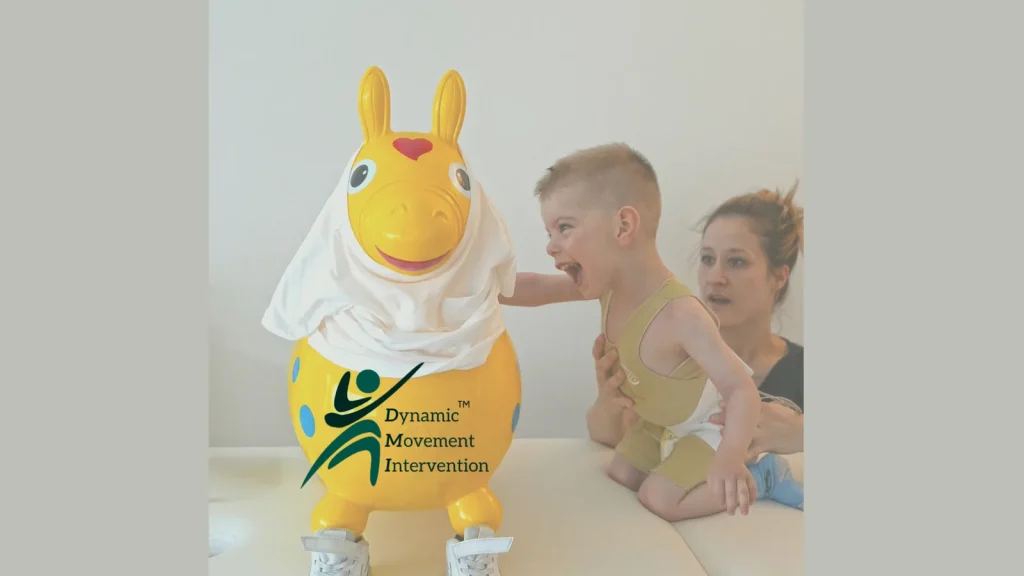
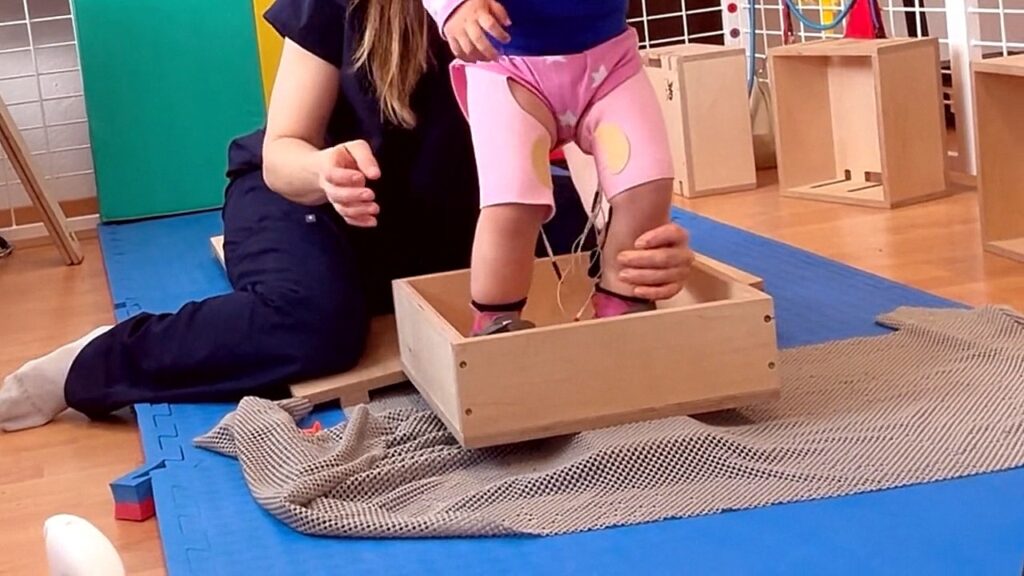
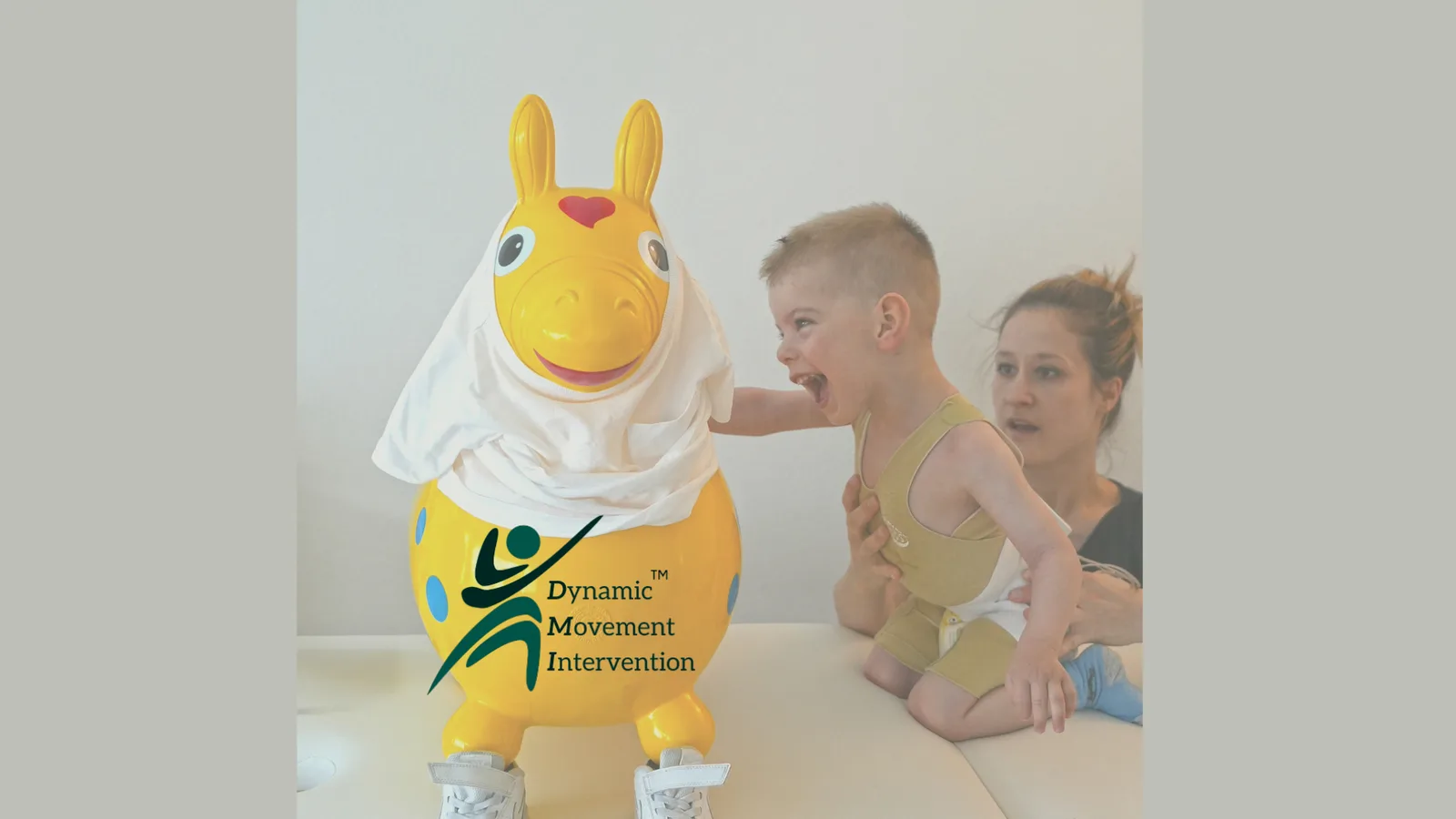
DMI therapy — Dynamic Movement Intervention — is a therapeutic approach built on a series of dynamic, gravity-loaded exercises for babies and children with motor delays. The therapist holds the child and gradually moves support further away from the body (for example from the hips to the knees, then to the ankles). With less support, the child’s sensory systems — touch, joint position sense and balance — receive strong new input, and the nervous system has to produce automatic postural responses: lifting the head, holding the trunk, catching balance, taking weight through the legs. Therapists usually work on a treatment table, on the floor or with simple equipment such as DMI boxes.
How a Dynamic Movement Intervention session works
From the outside, DMI exercises can look simple. However, they are not. The therapist chooses each one for a specific motor goal, grades its difficulty and adapts it second by second to how the child responds. The DMI founders describe the aim as provoking a specified active motor response from the child. In practice that means the child does the work — actively, not passively — while the therapist controls alignment, posture, safety and how much challenge gravity adds. The goal is to promote better postural control, strength and coordination, so that your child can build new skills such as rolling, crawling, sitting, standing and walking.
Which children is DMI for?
Therapists use Dynamic Movement Intervention for children with a variety of conditions, including cerebral palsy, Down syndrome, genetic syndromes, hypotonia, global developmental delay, acquired brain injury and babies born preterm. DMI can start in infancy. However, it is not suitable for every child: brittle-bone conditions such as osteogenesis imperfecta are a contraindication, and every child needs a medical and physiotherapy assessment first.
Prefer to watch? Our physiotherapists explain the method in a two-part video: What is it? Part 1 and Part 2 (YouTube, ApexaQLA Suisse English).
DMI in one minute:
- A series of dynamic exercises, typically done on a table or the floor, usually without orthoses.
- Support is gradually moved further from the body so the child’s nervous system has to respond.
- Goals are motor milestones: head and trunk control, crawling, sitting, standing, stepping, balance.
- It is a tool, and it only works with sound clinical reasoning and an experienced therapist. Certification is just the start: look for real experience and a transparent track record, not a collection of certificates.
The roots of DMI: from MEDEK to CME to DMI
First, to understand DMI, you need to know where it comes from. Dynamic Movement Intervention did not appear out of nowhere: its founders developed it as an evolution of CME, Cuevas Medek Exercises.
Ramón Cuevas and MEDEK (1970s)
CME was created by Ramón Cuevas, a Chilean physiotherapist who graduated from the University of Chile. According to the official CME website, he began working with children with cerebral palsy and Down syndrome in Caracas, Venezuela, in 1970, and created the method there from 1972. He first called it MEDEK — from the Spanish Método Dinámico de Estimulación Kinésica, a “dynamic method of kinesthetic stimulation”. In short, the core idea, still visible in DMI today, is that support applied further from the body provokes stronger antigravity reactions from the child.
From MEDEK to CME
Around 2000, Cuevas reorganised his international teaching programme, and the therapy’s name evolved from MEDEK to CME — Cuevas Medek Exercises. Therapists still learn and use CME worldwide today, and we use it at Apexa too (see our CME page).
Jake Kreindler, Jo-Anne Weltman and DMI (2021)
Two physical therapists, Jake Kreindler (USA) and Jo-Anne Weltman (Canada), introduced Dynamic Movement Intervention in February 2021. Both were long-time CME practitioners with CME Level III training. In their clinical commentary, they describe DMI as an evolution of CME. Compared with CME, they place more emphasis on alignment and postural control before adding challenge, on task-specific active movement, on retained infant reflexes, on standardised assessment, and on safe handling for the therapist. In addition, they removed what they call non-functional “tricks”.
DMI training follows a structured certification pathway: Introductory Levels A, B and C, Intermediate Levels A and B, and a master/teacher level. In addition, only therapists certified at Level C or higher may offer an official DMI intensive. Fabienne Theler, our clinical director, holds DMI Levels A, B, C and Intermediate A, and was the first therapist in Switzerland to complete the Intermediate A certification.
Follow the founders
- DMI — official website: dmitherapy.com · Instagram: @dmitherapy · founders’ profiles: About the founders
- CME — official website: cuevasmedek.com · Instagram: @cuevasmedekexercises · YouTube: Cuevas Medek Exercises
DMI vs CME: what is the difference?
Parents often ask whether DMI and CME are the same thing. They share the same family tree and the same core principle — gravity plus gradually reduced, distal support — but they are not identical.
Five key differences between DMI and CME
- Origin: CME was created by Ramón Cuevas from 1972; DMI was introduced in 2021 by Jake Kreindler and Jo-Anne Weltman as an evolution of CME.
- Alignment first: DMI puts more weight on good alignment and postural control before the challenge increases.
- Function: DMI aims for task-specific, functional movement and drops exercises its founders consider non-functional.
- Reflexes and assessment: DMI explicitly looks at retained infant reflexes and uses a standardised assessment.
- Age and goals: therapists classically use CME until a child walks independently, whereas they also use DMI with older children working on balance, stairs and uneven ground.
Fortunately, at Apexa we are trained in both. ORCA decides which one fits a child’s profile — and often the answer is “some of each, plus other tools”.
Why DMI alone is not enough
Here is the part that rarely appears in DMI videos: DMI is a structural tool — a useful one, but still a tool. A set of exercises cannot decide by itself which exercise your child needs today, how hard to push, when to stop, or what else your child needs to make the gains last. Instead, a therapist makes those decisions, and the results depend on them.
A child with cerebral palsy at GMFCS level IV, a toddler with Down syndrome and low tone, and a school-age child with ataxia may all “do DMI”. Yet their goals, their risks, their tolerance and the exercises that make sense are completely different. After all, doing the right exercise at the wrong time — too hard, too early, with poor alignment — wastes precious time at best and can cause harm at worst.
What a therapist and team add
For this reason, we say a child needs a therapist and a supportive team that go beyond DMI:
- Clinical reasoning: an experienced paediatric physiotherapist who reads the whole neuro-motor profile, not just a list of exercises.
- Measurement: standardised tests such as the GMFM and Peabody-3, so progress is visible in numbers, not impressions.
- A wider toolbox: suit therapy, TheraTogs, stimulation, casting, respiratory work — whatever the child needs alongside DMI.
- A team: neuropaediatricians, orthopaedic specialists, occupational and speech therapists, orthotists — with someone coordinating the picture.
- The family: coaching parents and caregivers so that what is learned in therapy carries over into everyday life, which is where motor skills really grow (see family-centred care).
Put simply: DMI exercises plus clinical reasoning plus a team plus the family. Together they can help unlock your child’s abilities and build real independence in daily life. Consequently, if you remove any one of these, much of the potential is lost.
How we integrate DMI into ORCA
That is why, at Apexa, DMI never runs on its own. Instead, we use it as a structural tool: it gives a session its backbone of graded, repeatable exercises, while the plan around it decides when, how often and with what else we use it. That plan sits inside ORCA — Objective Reasoning & Clinical Architecture, the clinical framework behind every child’s therapy plan, created by Fabienne Theler. Here is what each letter means for DMI:
What each ORCA letter means for DMI
- O — Objective: before any DMI session, we measure. GMFM, Peabody-3 and ICF-based goals give a clear baseline, so we know exactly where your child starts.
- R — Reasoning: we decide whether DMI is the right tool right now, which motor goals it should target, and how intensive it should be — or whether another method should come first.
- C — Clinical: a certified therapist delivers DMI and, where useful, combines it with CME, TheraSuit or the PediaSuit Protocol, stimulation and wearables, in an order that makes sense for the nervous system.
- A — Architecture: the order, dose and rhythm of therapy — weekly sessions, an intensive block, a home programme — reviewed and rebuilt as your child progresses.
DMI inside an ORCA intensive: an example
For example, in a typical intensive we might use DMI first to build the postural response a child needs, followed by suit or functional training that loads that response in real tasks, and finally a home programme that turns it into everyday movement. After the block, we re-measure. If the numbers and your observations don’t show progress, the architecture changes — that is the point of ORCA.
DMI in practice: children with PURA syndrome
Within the ORCA framework, DMI has become an integral part of therapy for many of the children we treat. Children with PURA syndrome are a good example. PURA syndrome is a rare genetic neurodevelopmental condition, caused by changes in the PURA gene, that typically brings marked low muscle tone (hypotonia) and delayed motor development. For these children, DMI provides what they need most: graded, repeatable challenges to postural control and anti-gravity strength, with support that the therapist doses precisely and reduces step by step.
In our clinical experience, children with PURA syndrome who follow an ORCA programme that includes DMI show clear, measurable improvements in their motor function. We document every child’s progress with standardised measures such as GMFM and Peabody-3, and we review the goals after each block. These are clinical observations from our centre, not trial results; nevertheless, they are consistent, and they are exactly why DMI is a core part of how we work with children with low muscle tone.
Our DMI qualifications at Apexa QLA:
- DMI certified: Levels A, B and C.
- DMI Intermediate A: the first in Germany, Austria and Switzerland, with the longest experience at this level.
- Lead therapist: MSc in Physiotherapy, King’s College London, one of the world’s leading universities.
- ORCA enhances every tool we use, DMI included: each session is linked to your child’s goals, guided by clinical reasoning within Family Centered Care, and measured with GMFM and Peabody-3.
DMI is a structural tool. A useful one, but still a tool. Without solid clinical reasoning, its potential is not reached.
Our clinical position at Apexa QLA SuisseWhy ORCA matters for your child
Parents of children with motor challenges are often handed a menu: DMI, CME, suit therapy, vibration, stimulation, robotics. Each method has passionate supporters. As a result, the risk is “method shopping” — moving from one technique to the next without a plan, a baseline or a way to know what is helping.
Why a framework protects your child
ORCA exists to protect your child — and your time, energy and money — from that. In other words, it is the umbrella over all the methods: you don’t have to choose the therapy; we assess, reason through your child’s profile and build one coherent plan. This is also what international guidelines for children with cerebral palsy recommend: early, goal-directed, task-specific, intensive and family-centred therapy, with outcomes measured over time (Novak et al., 2020; Jackman et al., 2022; Morgan et al., 2021). ORCA puts those principles into practice, and uses methods like DMI as one of the ways to deliver them.
Read more about the ORCA Method and our assessment.
What the research says — honestly
Families deserve a straight answer on evidence, so here it is. There are no controlled trials of DMI yet, and the DMI founders say so openly. However, “no trials yet” does not mean “does not work”: it means the research has not been done. In practice, we see children make real, measurable progress with Dynamic Movement Intervention, and the published cases point the same way.
Cases that show what DMI can do
- Apert syndrome (case report, 2026): a toddler who received DMI ten days a month went from 29% to 69% on the GMFM-88 motor scale between 16 and 24 months of age (Oreščanin et al., 2026). The child also had surgery and a daily home programme, so DMI was one part of the care — exactly as it is with us.
- Spinal muscular atrophy (case series, Johns Hopkins): in two children with SMA type 1 after gene therapy, motor scores on the CHOP-INTEND scale rose from 45 to 54 and from 54 to 62 over 25 weeks of DMI, and each child reached a new WHO motor milestone (Vela, MDA Clinical & Scientific Conference poster).
- CME, the method DMI grew from: published case reports describe two infants, one with hydrocephalus and one with a corpus callosum anomaly, who moved from “at risk” into the normal range on the AIMS motor scale; the second walked independently at 18 months (de Oliveira & Fabris Vidal, 2020; 2021).
- Our own children: at Apexa we measure every child before and after each block with GMFM and Peabody-3. Among others, we see clear, documented motor progress in children with PURA syndrome when DMI is part of their ORCA programme. For example, read our case study on motor progress after two intensives.
Of course, case reports cannot prove that a method works for every child. Nevertheless, they describe real children with real, measured gains, and they show why controlled trials are worth doing. Two randomised trials of DMI are already registered, in Pakistan and in Egypt (NCT07238634; NCT06270550); the first has finished, and its results are still to come. More research is needed, and we welcome it.
About the Paleg et al. paper
In 2026, Paleg and colleagues published a paper in Pediatric Physical Therapy that urges therapists to stop “legitimising” DMI and CME. Parents ask us about it, so here is our honest reading. The paper makes fair points about cost and about the need for trials. However, it has serious weaknesses that limit how much weight it can carry:
- It is a commentary, not a systematic review. The journal published it as a “Special Communication”, and the text calls itself a commentary. It has no methods section, no reproducible search and no formal rating of study quality.
- Its search for evidence was informal. According to the paper itself, part of the CME evidence came from the CME founder on request and from Google and Google Scholar searches.
- It treats “no trials” as “no evidence”. A lack of controlled trials shows that research is missing, not that a method is ineffective. In fact, the authors themselves note that there are no published data on harm from DMI or CME.
- It missed registered trials. The paper states that, as of March 2025, no DMI study appeared in the major trial registries. Yet a DMI trial from Cairo University was posted on ClinicalTrials.gov in February 2024. In addition, the paper does not mention the several registered randomised trials of CME.
- It collected no new data from children, families or clinicians, and it has no limitations section.
- Its authors have interests too. For instance, the paper discloses that the lead author is a paid consultant to a maker of standing and stepping equipment. That does not make the arguments wrong, but it is worth knowing.
The DMI founders have replied in the same journal (Kreindler & Weltman, 2026), and the debate continues. In short, the paper is an opinion piece — and not a strong one. It leaves too much untouched, as the examples above show, and it offers parents little practical guidance. Your time is better spent on what really counts: your child’s own goals and measured progress.
What the evidence does support
On the other hand, the principles DMI builds on have strong support: neuroplasticity — the brain’s ability to rewire through practice — and active, task-specific, repetition-rich practice, intensive and goal-directed training, early intervention and coaching families. That is exactly why we never sell Dynamic Movement Intervention as a stand-alone cure, and why ORCA measures every child, every block. We use DMI when our clinical reasoning says it fits, we show you the numbers, and we change course if it does not help.
Questions to ask any DMI provider:
- Which DMI level do you hold? (Only Level C or higher may run official DMI intensives.)
- How will you measure my child’s progress — which standardised tests, and when?
- Besides DMI, what else does my child need, and who coordinates it?
- What will we practise at home between sessions?
- And if we don’t see progress, how will the plan change?
DMI therapy: questions parents ask
Is DMI the same as Medek or CME?
No, but they are closely related. MEDEK was the original name of Ramón Cuevas’s method; later, it became CME (Cuevas Medek Exercises). Jake Kreindler and Jo-Anne Weltman then developed Dynamic Movement Intervention in 2021 as an evolution of CME.
Who created DMI therapy?
Physical therapists Jake Kreindler and Jo-Anne Weltman introduced DMI in February 2021. Both trained extensively in CME before they developed DMI.
Is DMI therapy evidence-based?
Not yet in the strict, trial-based sense: there are no controlled trials of DMI itself so far, although two are registered. Published case reports and our own measurements, however, show encouraging results. Moreover, evidence-based practice is more than research alone. It rests on three pillars that a good therapist weighs together (Sackett et al., 1996):
- 1. Best available research: what studies show. For DMI itself this pillar is still thin but growing: case reports show measurable motor gains, and the first trials are registered. Moreover, the principles it uses — active, intensive, goal-directed practice — are well supported.
- 2. Clinical expertise: the trained judgement of a certified therapist who assesses your child, chooses the right exercises, sets the dose and recognises when something is not working.
- 3. Your child and family: your goals, values and daily life, and how your child actually responds — measured, not guessed.
When one pillar is weak, the other two must be stronger. That is why we combine DMI with standardised measurement, so your own child’s results become part of the evidence, within an evidence-informed ORCA plan.
Prefer to watch? In this short video, Fabienne Theler explains what evidence-based really means for DMI and other methods: DMI & More: What is Evidence-Based? (YouTube, ApexaQLA Suisse English).
Can it help my child walk?
Above all, it can help build the postural control, balance and weight-bearing that walking depends on. Whether walking is a realistic goal depends on your child’s diagnosis, age and profile — something we discuss openly after an assessment, without promises.
From what age can children start?
DMI can start in infancy, when the nervous system is most adaptable. In addition, therapists use it with older children and teenagers working on balance and coordination.
Weekly sessions or an intensive?
Both work. For example, many families combine regular weekly therapy with periodic intensive blocks and a home programme. Ultimately, ORCA decides the rhythm for your child.
Can we do DMI exercises at home from videos?
Please don’t copy exercises from videos, because DMI handling is technical and the wrong exercise or poor alignment can be unhelpful or unsafe. Instead, your therapist will teach you specific, safe home activities that fit your child.
Is any therapist with a DMI course qualified?
DMI has several certification levels. So ask which level your therapist holds, how much DMI experience they have, and how DMI fits into their overall plan.
Is it safe?
In trained hands and after a proper assessment, DMI aims to be safe. However, it is not suitable for brittle-bone conditions, and the therapist must also consider medical issues such as hip problems or seizures. Good therapists adapt every exercise to the child’s reactions.
Why does my child cry during DMI?
DMI asks children to work outside their comfort zone, which can be frustrating at first. However, crying is not the same as pain; therapists watch closely and adapt. Our parent FAQ explains more.
Does insurance cover DMI therapy in Switzerland?
First of all, coverage varies case by case. Some insurers and the IV have covered individual sessions or intensive programmes with a doctor’s prescription. See our outlays & fees page.
How do we know if it is working?
We track it through standardised re-tests (such as the GMFM), video, written reports and your observations at home. So if progress stalls, we change the plan.
Sources, links and further reading
Research and official sources
- DMI Therapy — Parent resources & FAQ and clinical commentary by Kreindler & Weltman.
- Cuevas Medek Exercises — What is CME? and About Ramón Cuevas.
- Paleg G, Pool D, Hidalgo-Robles Á, et al. Where’s the evidence? Challenging therapists to stop legitimizing Dynamic Movement Intervention and Cuevas Medek Exercises. Pediatr Phys Ther, 2026;38(1):138–143. PubMed
- Oreščanin L, Biloglav Z, Škrlec I. Early motor development and rehabilitation outcomes in Apert syndrome (case report). Pathophysiology, 2026. PubMed
- Kreindler J, Weltman JA. Clarifying the scientific basis of Dynamic Movement Intervention (letter). Pediatr Phys Ther, 2026;38(2):335–337. PubMed
- de Oliveira GR, Fabris Vidal M. Cuevas Medek Exercises in a child with congenital hydrocephalus (case report). Clin Case Rep, 2020;8(7):1226–1229. PubMed
- Ramires de Oliveira G, Fabris Vidal M. Cuevas Medek Exercises in a child with a corpus callosum anomaly and congenital heart disease (case report). Clin Case Rep, 2021;9(8):e04637. PubMed
- Registered DMI trials: NCT07238634 (Lahore) and NCT06270550 (Cairo University).
- Sackett DL, Rosenberg WMC, Gray JAM, et al. Evidence based medicine: what it is and what it isn’t. BMJ, 1996. BMJ
- Novak I, Morgan C, Fahey M, et al. State of the evidence traffic lights 2019. Curr Neurol Neurosci Rep, 2020. PubMed
- Jackman M, Sakzewski L, Morgan C, et al. Interventions to improve physical function for children and young people with cerebral palsy: international clinical practice guideline. Dev Med Child Neurol, 2022. PubMed
- Morgan C, Fetters L, Adde L, et al. Early intervention for children aged 0 to 2 years with or at high risk of cerebral palsy. JAMA Pediatr, 2021. PubMed
More on our website
Video: what is it? Part 1 · Part 2 · Video: what is evidence-based? (Fabienne Theler) · Our method page · CME at Apexa · Parent FAQ · Case study: motor progress after two intensives · The ORCA Method.
Thinking about Dynamic Movement Intervention for your child? Start with an objective assessment and an honest conversation. We will map your child’s profile, explain our reasoning and show you the plan ORCA would build — with DMI where it fits, and everything else your child needs around it. Book an assessment or contact the team.
This article is for general information and does not replace an individual medical or physiotherapy assessment. Last reviewed: November 2026.