English
 Deutsch
 Español
 Français
 Italiano
 Nederlands
 العربية
 中文 (中国)
 Dansk
 Svenska
 Norsk
 Suomi
 日本語
 Polski

Methodology
Inside Apexa QLA Suisse: a paediatric rehabilitation centre in Switzerland built around our little superheroes
800 m² on the shore of Lake Zug, a team we call the Therapieavengers, a therapy dog named Lilly, and one clinical framework — ORCA — behind every plan. This is how our paediatric rehabilitation centre works, and why families travel from all over the world to train with us.
Every child who walks, crawls or is carried through our door is a superhero in the making. Some arrive with a diagnosis such as cerebral palsy, spina bifida or a genetic syndrome; some arrive after a stroke or a brain injury; some arrive with no name for their condition at all. What they share is potential — and a family who wants to give it every chance. This article takes you inside Apexa QLA Suisse: how we work, what we use, who we are and what a day here really looks like.
Who we are: a paediatric rehabilitation centre for complex conditions
Apexa QLA Suisse is a private paediatric rehabilitation centre in Zug, Switzerland, for babies, children and teenagers with neurological conditions, neuromuscular diseases and other complex conditions. We are an outpatient centre, not an inpatient rehabilitation hospital: children come for day sessions or intensive rehabilitation blocks while the family stays nearby. We are specialists in active, intensive neuro-motor rehabilitation — and complex cases are our focus, not the exception. Many children come to us after other therapy has stalled, with several conditions at once, or with rare presentations that do not fit any textbook. Our team has years of experience with exactly these children, and that specialist knowledge shapes how carefully we assess, plan and measure.
Families can contact us directly, and doctors and therapists can also make a referral. Every child starts with an evaluation, and every plan is tailored to the individual child.
Our starting belief is simple: your child is not a diagnosis — they are potential in motion. With the right intensity, the right tools and a family beside the child, the nervous system can keep learning. That belief is what we call the Apexa Way.
Conditions we work with
We work with children and young people with, among others:
- cerebral palsy of every type and level;
- spina bifida and spinal cord injury;
- stroke and traumatic brain injury;
- genetic syndromes, including Down syndrome and rare or undiagnosed conditions;
- neuromuscular diseases, hypotonia and ataxia;
- developmental delay, postural asymmetries and coordination difficulties, including early intervention for children aged 0–3.
Our approach: active, intensive, measured — on purpose
Traditional therapy often waits: a weekly session, a passive stretch, a slow watch-and-see. For many children that is simply not enough to drive real, lasting change. We chose a different path — modern, state-of-the-art paediatric rehabilitation built on three principles:
- Active — movement your child produces themselves (reaching, standing, stepping, balancing) builds motor pathways in a way passive handling never can. Our suits, suspension, stimulation and wearables exist to make that active movement possible, safer and more frequent.
- Intensive — enough repetitions, often enough, for the developing nervous system to change. That is why we offer concentrated intensive blocks as well as weekly therapy.
- Measured — we assess at the start, track throughout and report at the end with recognised tools such as the GMFM, Peabody-3 and ICF-CY. You see the curve, not just our reassurance.
The three pillars of evidence-based practice. Good rehabilitation rests on three pillars that work together: the best available research evidence; clinical expertise — experienced therapists who know how to apply that research to one particular child; and the values, goals and preferences of the child and family. Research alone cannot tell us what is right for your child, and neither can experience or opinion alone. Evidence-based care brings all three together (Veras et al., 2016).
Measuring what matters: GMFM, Peabody-3 and the ICF-CY
We measure with internationally recognised tools. The GMFM (Gross Motor Function Measure) tracks gross motor skills such as lying and rolling, sitting, crawling, standing, walking, running and jumping. It is one of the most widely used outcome measures in paediatric rehabilitation (Russell et al., 1989).
The Peabody Developmental Motor Scales, third edition (Peabody-3) assess gross and fine motor development in young children, so we can see how your child’s skills compare with typical development and how they change over time (Folio & Fewell, 2023).
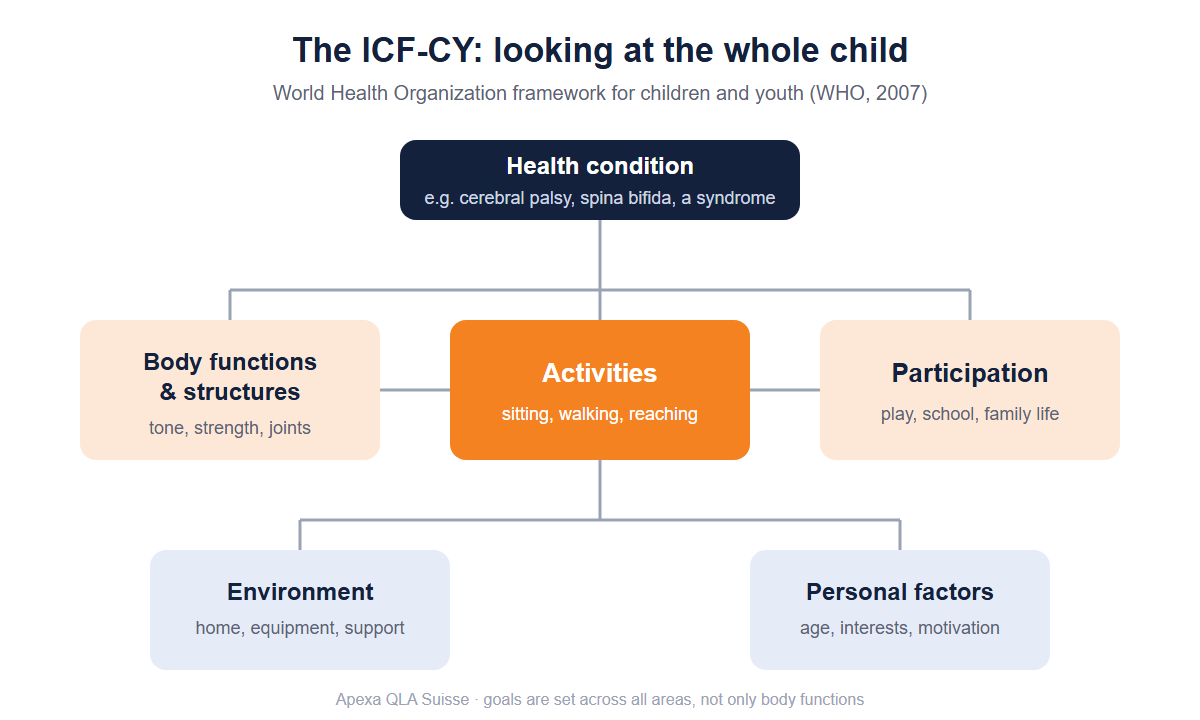
We plan with the ICF-CY — the World Health Organization’s International Classification of Functioning, Disability and Health for Children and Youth (WHO, 2007). It looks beyond the diagnosis at four areas together: body functions and structures, activities, participation in daily life, and the environment around your child. That is how we make sure therapy goals are goals that matter at home, at nursery and at school.
Parent enablement, case management and everyday life
Parent enablement. In our ORCA Enablement blocks we coach parents to become confident co-therapists, so your family becomes more independent and progress continues at home between visits.
Medical case management. If you wish, our case managers coordinate your child’s care — reports, appointments and communication with your doctors, specialists and therapists, so you have one point of contact.
Working with occupational therapists and other professionals
We work alongside your child’s occupational therapists, speech therapists, teachers and carers at home, share advice and reports, and make sure physiotherapy, occupational therapy, education and social care pull in the same direction — one multidisciplinary team around your child, wherever its members are based.
Your family portal: a direct line to the team
Every family gets access to our family portal at fam.apexaqla.ch — your direct line to the team at all times. In the portal you can speak to your therapists, upload videos of your child at home so we can give feedback, find your child’s reports and progress measurements, see invoices and financial information, read articles about therapy, and much more.
The ORCA Method: one architecture, built from your child up
Behind every plan is the ORCA Method — Objective Reasoning & Clinical Architecture — created by our lead therapist Fabienne Theler, MSc PT. ORCA is not a machine and not a fixed programme. It is a clinical-reasoning framework that reads your child’s neuro-motor profile and decides which method to use, when, in what order and at what dose — and then re-measures, so the plan keeps pace as your child grows.
- O — Objective: we start from measurement, not impression.
- R — Reasoning: we read the whole profile and decide what to work on next.
- C — Clinical: proven, modern methods applied with hands-on expertise.
- A — Architecture: the order, the dose and the rhythm, reviewed and rebuilt as your child progresses.
You never have to choose a therapy off a menu. That is exactly what ORCA is for.
Modern therapies and the tools we use
ORCA draws on six families of tools. Each one is chosen for a reason, and we always explain the “why” behind it.
Movement and motor learning
- DMI (Dynamic Movement Intervention) — exercises against gravity that provoke automatic responses and build motor milestones step by step. DMI uses neuroplasticity — the brain’s ability to form and strengthen connections through active, repeated practice — by asking for responses the child cannot yet make easily, until they become automatic.
- CME (Cuevas Medek Exercises) — dynamic exercises that challenge balance and postural control.
- Apexi Bounce — playful, active movement work.
Suits and suspension
- PediaSuit Protocol and TheraSuit — dynamic suits that support alignment and loading during intensive training.
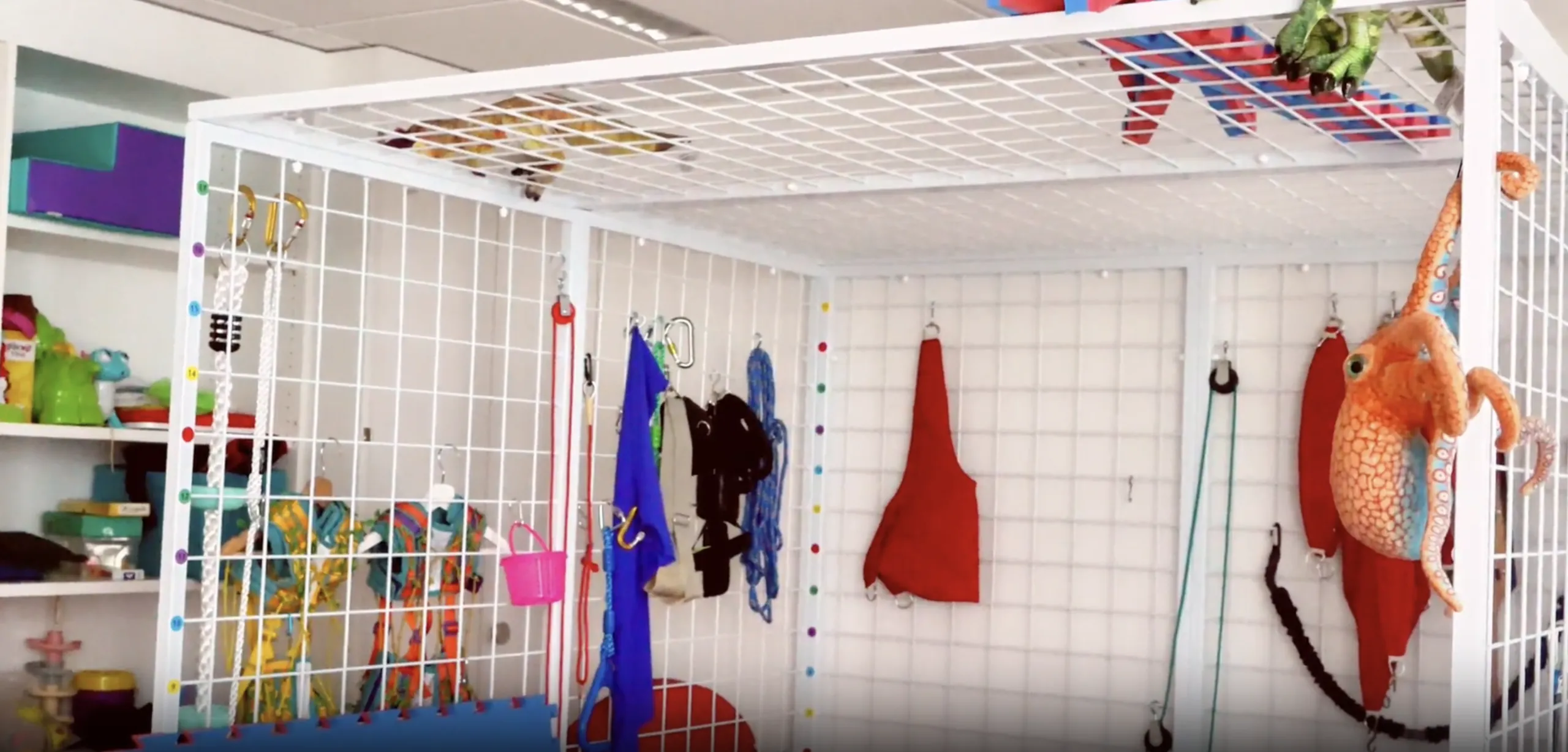
- The Spidercage — a playful harness and suspension system that lets children stand and move independently, safely.
Stimulation and activation
- NISE-Stim — non-invasive spinal and muscle stimulation.
- TASES — task-specific electrical stimulation, paired with active movement.
- Galileo — side-alternating vibration plates that gently wake up and strengthen muscles before and during therapy.
Wearables and alignment
- TheraTogs — wearable orthotic garments that support posture and alignment gently, all day long.
- Bamboo Braces — soft, dynamic elbow braces that encourage active arm use.
- Apexi Dynaflex Casting — to improve range and alignment so active therapy has more room to work.
Respiratory therapy
- ORCA-Flow — breathing and lung-function work, because breathing is the foundation of movement and endurance.
Assessment and tracking
- GMFM, Peabody-3 and ICF-CY, small daily measurements during intensives, and a final ORCA report you can share with your doctors and your insurer.
We are the TheraTogs experts
TheraTogs only work when they are fitted right — the correct system, the correct size, the correct straps and a clear wear schedule. Our certified TheraTogs fitters are recognised worldwide, are part of the international TheraTogs fitter network and were trained by the inventor of TheraTogs, Beverly (Billy) Cusick. They assess, size and fit every system precisely for your child, and adjust it as your child grows. We also train and certify other therapists and professionals as TheraTogs fitters — the coursework online, and the hands-on part in the lab at our Zug centre.
800 m² on Lake Zug: our therapy universe
Our centre, Rive du Lac, offers 800 m² of therapy space on the shore of Lake Zug, facing Mount Rigi. It was designed for children and families first:
- Step-free throughout — wide corridors for strollers and wheelchairs, from the entrance to every therapy room.
- Bright natural light — large windows and warm daylight, with a calm view over the lake.
- Sensory-friendly — quiet, low-stimulation waiting spaces where sensitive children feel safe and settled.
Inside, every zone has a purpose:
- The active gym floor — our main open space for intensive movement therapy, with room to crawl, stand, step and play.
- Spidercage and suspension — where children practise standing and moving with just enough support.
- Galileo activation plates — for muscle activation before and during therapy.
- Private assessment rooms — calm spaces for assessments and one-to-one sessions, away from the busier gym floor.
- Lilly’s cosy corner — home base for our therapy dog.
New places can feel big for a child, so you can explore the centre from home first with our 3D tour, and see real moments from therapy days in our photo gallery.
Meet the Therapieavengers: our multidisciplinary team
Every superhero needs a team. Ours are the Therapieavengers — therapists, specialists and assistants selected from around the world and deeply trained, each with their own superpower:
- The Kinetic Mages — our therapists, with certifications across DMI, CME, PediaSuit, TheraTogs, casting, Spidercage, Galileo, ORCA and early intervention for children from birth to three.
- The Guild Masters — our coordinators, who handle parent liaison, reimbursement questions, travel, accommodation, planning and billing, calmly and clearly.
- The Legendary Companion — Lilly, our therapy dog, master cuddler and full-time morale officer. She is often the first friend a child makes here.

How we support children and young people — and their families
After a free introductory call and an assessment, we recommend the rhythm that fits your child and adapt it as they grow. There are four ways to work with us (see programmes):
- Weekly therapy — 50-minute one-to-one sessions, for steady, maintainable progress close to home.
- ORCA Intensive — our most chosen programme: blocks of one to four weeks with several hours of active therapy a day, a full assessment, an ORCA report and parent coaching built in.
- ORCA Enablement — three to five days in which we turn parents into confident co-therapists, the natural next step after intensives.
- Virtual visits — live video assessment, coaching and a home programme, ideal between intensive blocks.
A day in an intensive rehabilitation block
Mornings start with gentle muscle activation on the Galileo plates and a play-led warm-up. Midday is the core: intensive, repetition-rich active therapy with suspension and suit work, paced with rest and play. In the afternoon your child practises the day’s milestone, followed by a short parent session with practical strategies so you can carry it home into everyday life. The aim is always the same: to build strength, mobility and your child’s participation in daily life, in a consistent way. Small measurements are logged every day and feed into the final ORCA report.
Families from all over the world
We are one small centre on Lake Zug, but families travel from all over the world to Zug for modern therapies and the latest advances in paediatric rehabilitation — from 16 countries on four continents — Europe, the Americas, Asia and Australia — with many travelling from across Europe and the Balkans. Parents rate us 4.9 out of 5 on Trustpilot and Google.
Travelling for therapy should not mean worrying about everything else. Our concierge handles what is not the therapy itself — travel, transfers, accommodation and ideas for family time around Zug — from your first email to the last goodbye at the airport.
Our promises to every family
We have written our commitments down so you can hold us to them. Among our promises:
- every plan is built for one child — never a template;
- we measure progress with objective data, not opinions, and never promise outcomes we cannot evidence;
- we coordinate with your paediatrician, specialists and therapists at home;
- a warm lunch on therapy days, for your child and for you;
- a room for brothers and sisters, and a quiet space where your little one can nap;
- ORCA@HOME coaching, so progress continues every day at home;
- a direct line to your lead therapist, so questions never have to wait.
Questions parents often ask
Where is Apexa QLA Suisse?
Our centre, Rive du Lac, is in Zug, Switzerland, on the shore of Lake Zug — about half an hour from Zurich.
Do we need a referral?
No. You can contact us directly for a free introductory call. If your doctor or therapist would like to refer your child, they are very welcome to get in touch, and we will receive their advice and reports before the first evaluation.
Which children benefit from your service?
Children at every stage can benefit — from babies with early symptoms of motor delay to teenagers after injuries such as a brain or spinal cord injury. Our young patients and their families have direct access to their lead therapist, are involved in every treatment decision, and learn to continue therapy effectively at home. Many families receive advice from us before their first visit.
Do I have to choose the therapy method myself?
No. We assess your child and the ORCA Method decides which methods to use, in what order and at what dose. We explain every choice.
Do you treat children from outside Switzerland?
Yes. Families travel from 16 countries for intensive blocks, and our concierge helps with travel and accommodation. Virtual visits support you at home between blocks.
Can siblings come along?
Yes. We have a play room for brothers and sisters, a quiet space where your little one can nap, and a warm lunch on therapy days for your child and for you — so the whole family is welcome.
How long is an ORCA Intensive?
One to four weeks, with several hours of active therapy a day, a full assessment, an ORCA report and parent coaching built in. We also offer weekly 50-minute sessions, ORCA Enablement blocks of three to five days, and virtual visits between blocks. We recommend the rhythm that fits your child after the introductory call and assessment.
What does therapy cost?
Costs depend on the programme and on the length and content of your child’s block, so there is no single price. You will find our current prices on the costs and fees page, and we are transparent about costs from the very start.
Will health insurance pay?
That depends on your country, your insurer and your child’s situation, so we cannot promise coverage. We provide a final ORCA report and progress measurements that you can share with your doctors and your insurer, and our coordinators help with reimbursement questions. It is worth asking your insurer before you book.
How do I start?
For further information or to book a free, no-obligation introductory call, use our contact page. We look forward to meeting you — and your little superhero.
References
- Veras, M., Kairy, D., & Paquet, N. (2016). What is evidence-based physiotherapy? Physiotherapy Canada, 68(2), 95. doi.org/10.3138/ptc.68.2.gee
- Folio, M. R., & Fewell, R. R. (2023). Peabody Developmental Motor Scales (3rd ed.). Pro-Ed.
- Russell, D. J., Rosenbaum, P. L., Cadman, D. T., Gowland, C., Hardy, S., & Jarvis, S. (1989). The gross motor function measure: A means to evaluate the effects of physical therapy. Developmental Medicine & Child Neurology, 31(3), 341–352. doi.org/10.1111/j.1469-8749.1989.tb04003.x
- World Health Organization. (2007). International Classification of Functioning, Disability and Health: Children and Youth Version (ICF-CY). WHO.
Clinical content on this website is reviewed by Fabienne Theler, MSc PT.