 English
 Deutsch
 Español
 Français
 Italiano
 Nederlands
 العربية
 中文 (中国)
 Dansk
 Svenska
 Norsk
 Suomi
 日本語
 Polski

Films & series
Out of My Mind film review: what Disney’s cerebral palsy film gets right — a therapist’s view for parents
A clever girl with cerebral palsy who cannot speak, a talking device that finally lets the world hear her, and a school that has to learn to listen. Our review of Out of My Mind (Disney+, 2024) — what it shows honestly, what it leaves out, and how to watch it with your family.
At Apexa QLA Suisse we spend our days with children who understand far more than they can show. So when a family film puts exactly that experience at its centre, we watch closely. Out of My Mind is one of the most honest portrayals of cerebral palsy in a mainstream film so far — and a good conversation starter for families, classmates and teachers.
Out of My Mind at a glance
- Released: premiered at the Sundance Film Festival in January 2024; streaming on Disney+ since November 2024.
- Based on: the 2010 bestselling novel by Sharon M. Draper.
- Director: Amber Sealey; screenplay by Daniel Stiepleman.
- Cast: Phoebe-Rae Taylor as Melody, with Rosemarie DeWitt and Luke Kirby as her parents, Judith Light as Mrs. V, and Jennifer Aniston as the voice of Melody’s thoughts.
- Length: 102 minutes.
- Awards: a Peabody Award and a Television Academy Honor in 2025.
- Best for: families with children from about 9 years, school classes, and anyone who works with children with disabilities.
What the film is about (no major spoilers)
Melody Brooks is eleven. She has cerebral palsy, uses a powered wheelchair and cannot speak. She also has a photographic memory, sees music as colour, and knows the answer to almost every question — but nobody can hear her. The film lets us hear her thoughts, voiced by Jennifer Aniston, so we know from the first minute how much is going on inside.
When an inclusion programme brings Melody into a mainstream sixth-grade class for part of the day, she meets a teacher who underestimates her, classmates who do not know how to talk to her, and one girl, Rose, who tries. Everything changes when Melody gets a Medi-Talker — an electronic speech device that turns what she types into words. For the first time she can answer, joke, argue and compete. She earns a place on the school’s quiz team. And then the film asks the harder question: when a child can finally speak, will the people around her actually listen?
Why it matters that Melody is played by an actress with cerebral palsy
Phoebe-Rae Taylor, a teenager from England, has cerebral palsy herself and uses a wheelchair. The director searched worldwide for an actress with CP, and Taylor was cast from a home-made audition tape. It shows on screen: the way Melody moves, reaches, drives her chair and uses her whole body to communicate is real, not imitated.
For the children we work with, that matters enormously. Seeing someone who moves like you as the hero of a Disney film — clever, funny, stubborn and sometimes angry — is rare. Representation is not a detail; it shapes how classmates see a child with a disability, and how that child sees themselves.
What the film gets right — our view as therapists
Understanding is not the same as speaking
This is the heart of the film, and it is true. Many children with cerebral palsy have difficulty controlling the muscles of the mouth, throat and breathing that speech needs. That says nothing about what they understand. We meet children every week whose eyes, smiles and gestures tell us they have followed every word. The film’s greatest strength is that it never lets the audience forget this.
A communication device is a voice, not a gadget
The moment Melody first uses her Medi-Talker is the emotional centre of the film. Today these tools are called AAC — augmentative and alternative communication — and they range from picture boards and signs to tablets and eye-gaze systems that a child controls with their eyes. The film shows something every family who has introduced AAC will recognise: the device does not just let a child answer questions; it lets them tell jokes, disagree and be themselves.
Low expectations are a barrier too
Melody’s biggest obstacles are not her body. They are a teacher who does not mark her test, classmates who leave her out, and an airport lift that is out of order. That is what the social model of disability means in practice: barriers in the environment and in attitudes often disable a child more than the condition itself. It is also why we plan therapy with the ICF-CY, the World Health Organization’s framework that looks at participation and environment, not only at muscles and joints.
Families carry a lot
The film is honest about how tired, protective and sometimes overwhelmed Melody’s parents are — and about the younger sister who also needs attention. Many parents we meet will recognise themselves. It is one of the reasons parent coaching and support are built into everything we do.
What the film leaves out or simplifies
- Learning AAC takes time. In the film, Melody uses her device fluently almost at once. In real life, children usually need months of practice, the right vocabulary set-up, a good seating position and a team that models the device every day.
- Movement and therapy are mostly off screen. We see little of the daily work that helps a child with CP sit, reach, control a wheelchair or use a device more easily. Posture, head control and hand or eye control all affect how well a child can communicate.
- Cerebral palsy looks different in every child. Melody has severe motor involvement and strong intellectual abilities. Other children with CP walk, talk and run, and some have learning difficulties as well. One film cannot show them all.
- Inclusion is shown as a programme, not a team effort. Good inclusion at school depends on teachers, assistants, therapists and parents working together — something the film only touches on.
How we work with children like Melody
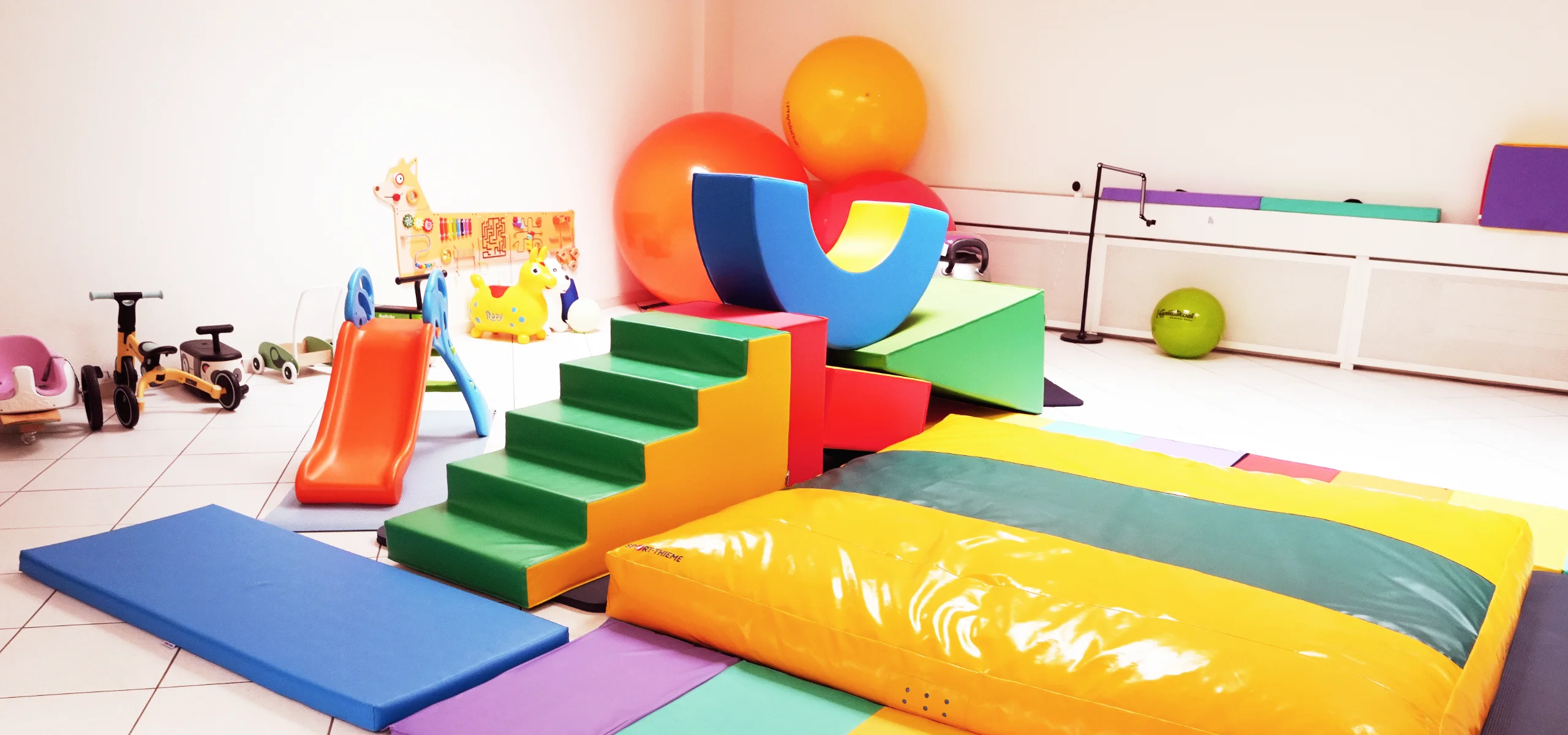
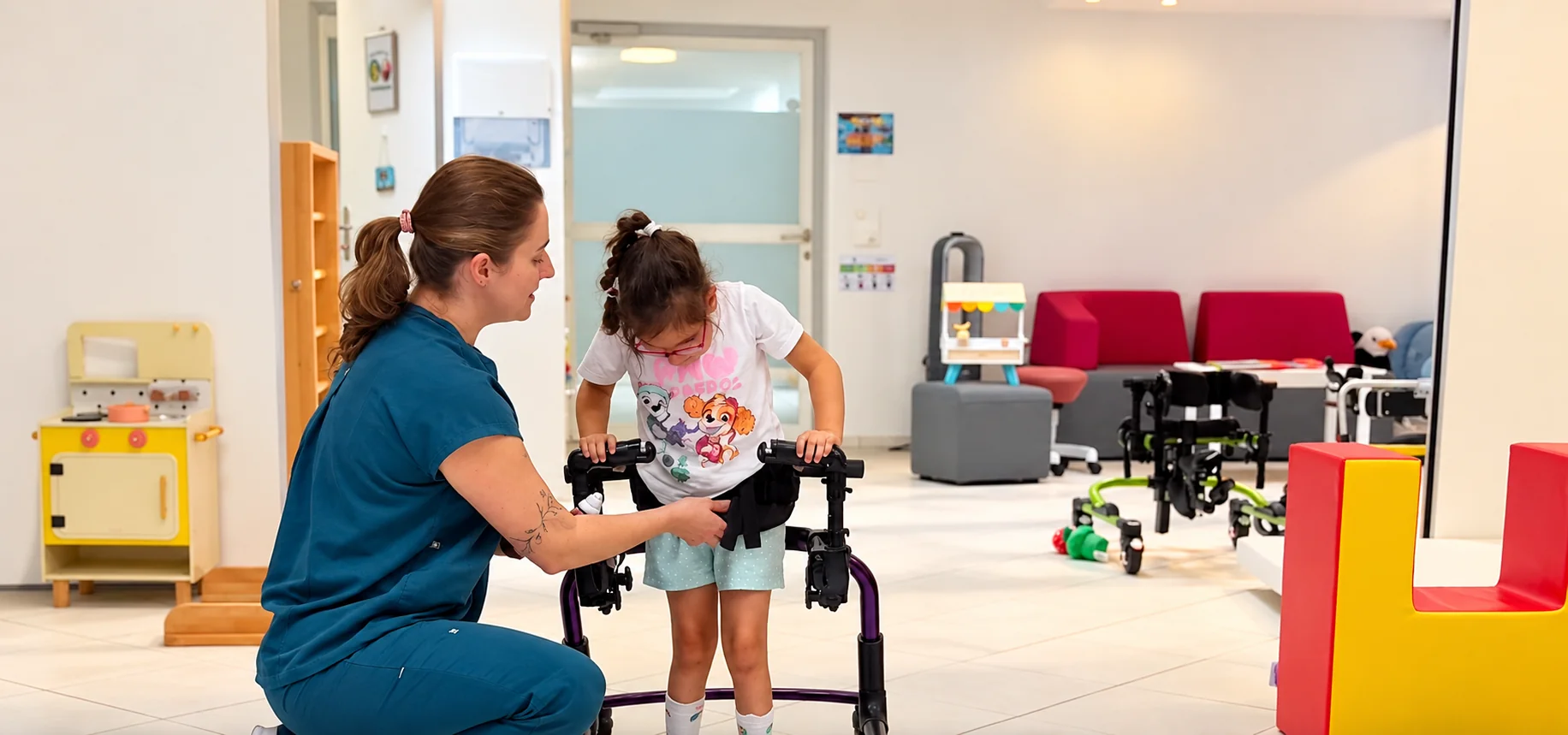
We are a specialist paediatric rehabilitation centre in Zug for children with complex neuro-motor conditions, including cerebral palsy. Our team has experience with children who cannot speak and who communicate with their eyes, gestures, signs or devices, and complex cases are our focus. Communication and movement are closely linked: a stable sitting position, good head control and a reliable way to point, press or look make every form of communication easier.
- We plan every child’s therapy with the ORCA Method (Objective Reasoning & Clinical Architecture), created by our lead therapist Fabienne Theler, MSc PT.
- We use active, modern therapies such as DMI, suit therapy and the Spidercage to build trunk and head control, and TheraTogs for alignment through the day. We are the TheraTogs experts: our certified fitters are recognised worldwide and were trained by the inventor of TheraTogs, Beverly (Billy) Cusick.
- We measure progress with the GMFM and Peabody-3 and set goals with the ICF-CY, so goals include participation at home and at school.
- We work alongside your child’s speech and language therapist, AAC specialist and school, and — if you wish — act as your child’s medical case manager.
Read more about cerebral palsy and our intensive therapy for cerebral palsy.
Watching Out of My Mind with your family
Is it suitable for children? It is a family film, but it has emotional scenes, including exclusion by classmates and a frightening family accident. We would suggest it from about nine years, watched together.
Questions to talk about afterwards:
- How did Melody feel when people talked about her instead of to her?
- What changed when she got her talker? What stayed the same?
- How could Melody’s classmates have included her better?
- Do you know someone who communicates in a different way? How can we make it easier for them to join in?
For siblings and classmates: the film is a gentle way to explain that a child who cannot speak can still think, feel and have opinions — and that waiting for an answer is a form of respect.
Our verdict
Out of My Mind is warm, funny in places, sometimes painful and, above all, respectful. It does not turn Melody into a lesson or a saint; it lets her be a real eleven-year-old with a sharp mind and a temper. It simplifies the hard work behind communication and therapy, but its central message is one we would sign without hesitation: presume competence, and listen.
Our rating: 4.5 out of 5 — highly recommended for families, schools and everyone who works with children with disabilities.
Questions parents often ask
Where can I watch Out of My Mind?
The film streams on Disney+, which is available across most of Europe, including Switzerland.
Is Out of My Mind based on a true story?
No. It is based on the novel by Sharon M. Draper, whose own daughter has cerebral palsy and who drew on her experience as a teacher and parent.
What is the device Melody uses?
In the film it is called a Medi-Talker. Real-life equivalents are AAC devices — speech-generating tablets or eye-gaze systems. A speech and language therapist assesses which system suits a child.
Can therapy help a child like Melody communicate?
Communication is mainly the work of speech and language therapists and AAC specialists. Movement therapy supports it: better trunk and head control, a stable seating position and more reliable hand or eye control can make using a device easier. We work with your child’s communication team towards the same goals.
Is Out of My Mind suitable for children?
It is a family film, but it has emotional scenes, including exclusion by classmates and a frightening family accident. We suggest it from about nine years, watched together, so you can talk about it afterwards.
Who plays Melody, and does she have cerebral palsy?
Melody is played by Phoebe-Rae Taylor, a teenager from England who has cerebral palsy herself and uses a wheelchair. She was cast from a home-made audition tape after a worldwide search for an actress with CP.
What is cerebral palsy?
Cerebral palsy is a group of conditions that affect movement and posture, caused by damage to or differences in the developing brain before, during or soon after birth. It is the most common physical disability in childhood. The brain injury itself does not get worse, and every child with CP is different: some walk and talk, others use a wheelchair and a communication device.
If a child cannot speak, how much do they understand?
Not being able to speak says nothing on its own about what a child understands. Many children with cerebral palsy find it hard to control the muscles that speech needs, yet follow every word around them. A speech and language therapist can assess understanding in ways that do not depend on speech.
What does “presume competence” mean?
It means assuming that a child understands and has something to say, and giving them the time and tools to show it — rather than waiting for proof first. In practice: talk to the child, not about them, wait for answers and offer a way to respond. It is the central message of the film, and one we share.
Next step: talk to us
If your child has cerebral palsy and you would like to know how modern rehabilitation could help, book a free introductory call through our contact page. Families travel from all over the world to Zug for modern therapies and the latest advances in paediatric rehabilitation.
Film review by the Apexa QLA Suisse team. Clinical content on this website is reviewed by Fabienne Theler, MSc PT.