English
 Deutsch
 Español
 Français
 Italiano
 Nederlands
 العربية
 中文 (中国)
 Dansk
 Svenska
 Norsk
 Suomi
 日本語
 Polski

Parent guides
AAC for children: how children who cannot speak find their voice — a guide for parents
Augmentative and alternative communication (AAC) gives children who cannot speak, or cannot be understood, a way to say what they think. What AAC is, which systems exist, what the research says about speech, how movement and seating affect communication — and how we work with your child’s communication team.
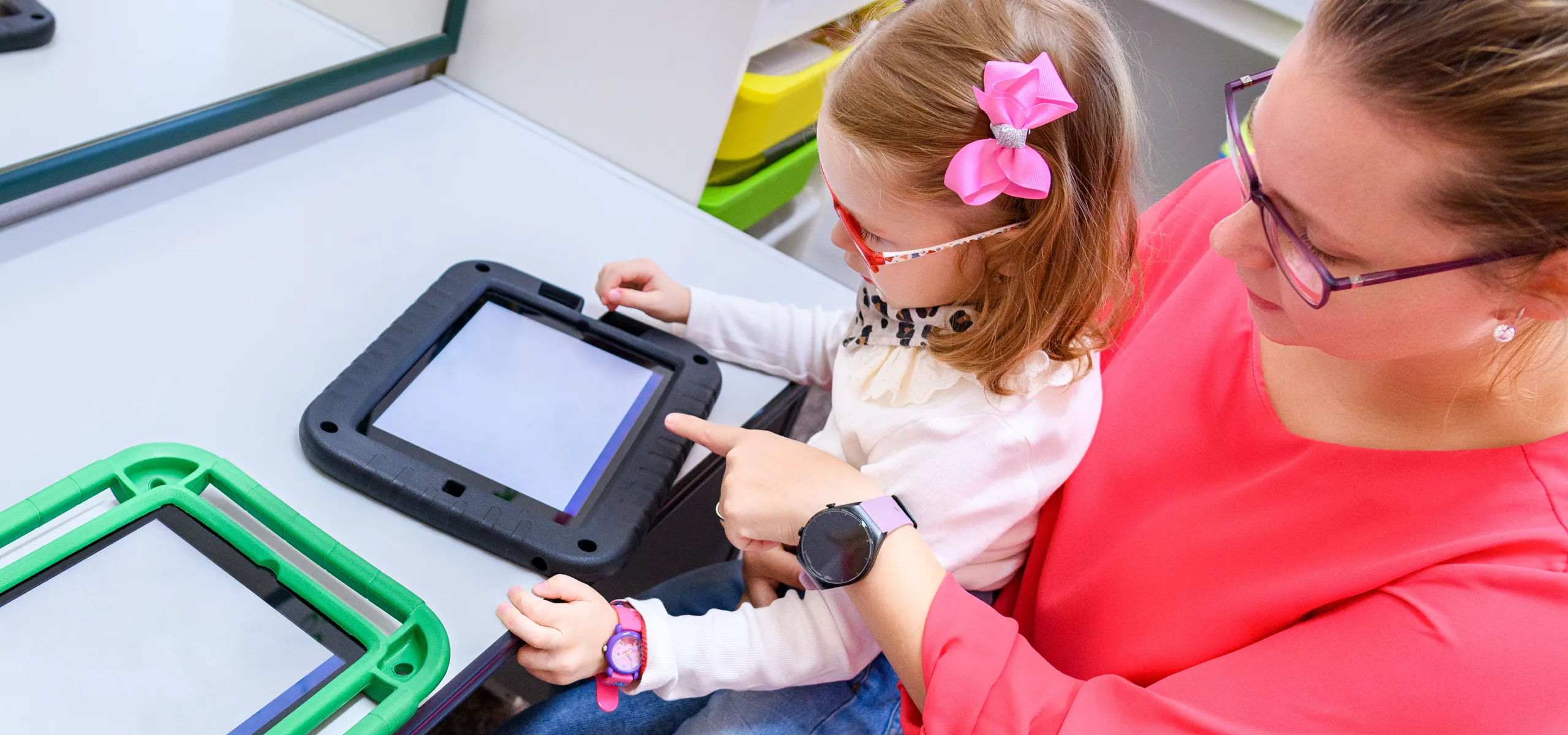
Some children understand almost everything around them but cannot say a word. Others speak, but only their family can understand them. For these children, and for their parents, every day can be full of guessing: Is she hungry, tired, in pain, bored, or does she want to tell me something important? AAC changes that. This guide explains augmentative and alternative communication for children plainly, so you know what to ask for and what to expect.
What is AAC? Augmentative and alternative communication explained
Augmentative and alternative communication (AAC) means every way of communicating other than speech. Augmentative means it adds to speech that is there but limited; alternative means it replaces speech when a child cannot speak at all. We all use AAC sometimes — a wave, a thumbs-up, a written note. For children and young people with complex communication needs, AAC becomes their main voice. It is sometimes also called alternative and augmentative communication, or simply augmentative communication.
AAC is more common than many people think. The UK charity Communication Matters estimates that around one in 200 people may need AAC at some point in their lives.
AAC is used by children with many conditions, including cerebral palsy, genetic syndromes such as Rett or Angelman syndrome, autism, childhood apraxia of speech, and acquired brain injury. In cerebral palsy alone, a large systematic review found that about one in four children cannot talk (Novak et al., 2012).
Signs your child may benefit from AAC
Every child develops at their own pace, but these signs suggest it is worth asking a speech and language therapist about AAC:
- your child understands much more than they can say, or is non speaking;
- spoken words are very hard for people outside the family to understand;
- speech development has stalled, or language development is clearly behind;
- your child gets frustrated, cries or withdraws because they cannot make themselves understood;
- your child relies mainly on body language, pointing or pulling you to things.
AAC does not wait for these communication difficulties to “become serious”. Introduced early, it helps reduce frustration and lets a child become an active participant in family life, play and learning.
Types of AAC
Unaided communication: the body as the voice
- Facial expressions, eye pointing and gestures — often a child’s first and most reliable signals.
- Manual signs and sign language — key word signing systems used alongside speech, or a full sign language such as British Sign Language in the UK or the national sign languages used across Europe.
Unaided AAC is always available — but it depends on hand and body movement, and on communication partners who know the signs.
Aided communication: tools that carry the message
- Low-tech AAC — picture cards, symbol boards, communication books (such as PODD books), alphabet and letter boards, and eye-gaze frames. Cheap, robust and always available, even when the battery is flat.
- High-tech AAC — speech-generating devices and tablets with communication apps that speak aloud when a child selects symbols, words or letters. This is the kind of “talker” Melody uses in the film Out of My Mind.
- Eye-gaze systems — cameras that track where a child looks, so a child who cannot use their hands reliably can select words with their eyes.
Paper-based AAC: low tech, always ready
Paper based AAC — symbols and line drawings, photos, written words or letters on communication boards and communication books — is often where a child starts. It never runs out of battery, works in the bath and at the beach, and is a reliable back-up for every high-tech system.
Electronic communication aids and AAC apps
Electronic communication aids range from simple single-message buttons to voice output communication aids (VOCAs) and speech generating devices with thousands of words. Common examples are dedicated touchscreen tablets such as Grid Pads, keyboard-based devices such as Lightwriters for children who can spell, and an AAC app on a standard tablet. Together with switches, mounts and eye-gaze cameras, this is what professionals mean by assistive technology or AAC equipment.
Most children use a mix: a smile and a gesture with family, a symbol board at the swimming pool, a speech-generating device at school. That is not a problem — it is good communication.

Will AAC stop my child from learning to speak?
This is the question parents ask most, and the answer from research is clear: no. A research review of AAC intervention in children and adults with developmental disabilities found that none of the individuals in the best-quality studies spoke less after AAC was introduced, and most (89%) actually showed gains in speech (Millar, Light & Schlosser, 2006). AAC takes the pressure off, gives children a reason to communicate, and models language every time it is used.
AAC also supports language skills more broadly: expressive language, understanding of spoken language and, later, written language. AAC use and speech can grow together.
Other common myths:
- “My child is too young.” There is no minimum age. Babies and toddlers can start with eye pointing, choice-making and simple symbols.
- “My child needs to show certain skills first.” There are no prerequisites. Children learn to use AAC by using it — just as babies learn to talk by being talked to.
- “A device is a last resort.” AAC works best when it starts early, not after years of frustration.
How an AAC assessment works
An AAC assessment is usually carried out by a speech and language therapy service, sometimes together with specialised AAC services. It looks at much more than speech:
- Understanding and language — what your child understands, and how they express themselves now.
- Vision and hearing — how big symbols need to be, and whether a voice output is helpful.
- Movement and access — how your child can point, touch, look or use a switch, often with input from physiotherapists and occupational therapists.
- Daily life — where your child needs to communicate: at home, at the child’s school, with family members and friends.
- Environment — the ICF-CY reminds us that environmental factors, such as trained communication partners and access to equipment, influence AAC decisions as much as the child’s own abilities.
A good assessment ends with a trial period, a clear plan, and support to get the right equipment funded. Ask your healthcare professionals about further support with funding — it varies between countries and insurers.
How communication and movement are connected
To communicate with AAC, a child has to access it — point, press, touch, look, or use a switch. That depends on movement. This is where rehabilitation and communication meet:
- Sitting and posture. A child who has to fight to stay upright has little energy left to communicate. A stable pelvis, good trunk support and the right seating make every form of AAC easier.
- Head control. Eye-gaze systems and eye pointing need a child to hold their head steady enough for long enough.
- Hand and arm control. Direct selection with a finger is the fastest way to use AAC; better arm control can turn a slow switch user into a direct selector.
- Breathing. Breath support affects voice, sounds and stamina for any communication.
- Positioning the device. The device must be where the child can reach or see it — on a wheelchair mount, a table or a stand — in every position the child uses during the day.
Children with cerebral palsy are often described using the Communication Function Classification System (CFCS), which looks at how effectively a child communicates in everyday life with familiar and unfamiliar people (Hidecker et al., 2011). Together with motor classifications, it helps the whole team understand a child’s profile.
Who helps with AAC? Speech and language therapists and the wider team
AAC is a team effort. The speech and language therapist assesses communication, chooses and sets up the AAC system with you, and teaches its use; specialised AAC centres often help with assessment and funding of high-tech devices. Occupational therapists and physiotherapists look at seating, positioning and access. Teachers and assistants use AAC in class. And you, the family, are the most important communication partners of all.
Training communication partners
Research highlights the importance of training communication partners — the people who talk with AAC users every day. A child with the best device will still struggle if the people around them do not wait, do not model, and only ask yes-or-no questions. Training family members, teachers, special educational staff and friends is one of the most effective ways to support communication.
Practical tips for parents introducing AAC
- Model, model, model. Use the AAC system yourself when you talk to your child — point to the symbols while you speak. Children learn AAC the way other children learn speech: by seeing it used all day.
- Keep it with your child. A device in a cupboard is no voice at all. It should be charged and within reach everywhere — at home, in the car, at the playground.
- Wait. AAC takes time. Count to ten silently before you help. Waiting is a form of respect.
- Accept every form of communication. A look, a sound, a sign and a device all count.
- Talk about more than needs. Make sure your child can also joke, comment, complain, ask questions and say “I love you” — not only “drink” and “toilet”.
- Share with everyone. Grandparents, siblings, friends and teachers all need to know how your child communicates. Our guide to inclusion at school has more on this.
How we support communication at Apexa QLA Suisse
We are a specialist paediatric rehabilitation centre in Zug for children with complex neuro-motor conditions, and complex cases are our focus. Our team has experience with children who communicate with their eyes, gestures, signs and devices. We are not a speech therapy service; our job is the movement side of communication, and we work closely with your child’s speech and language therapist and AAC team.
- Building the foundations. Active, modern rehabilitation — DMI, suit therapy and the Spidercage — builds trunk control, head control and sitting balance, the base for pointing, looking and using a device. DMI uses neuroplasticity — the brain’s ability to form and strengthen connections through active, repeated practice — by asking for responses a child cannot yet make easily.
- Posture through the day. TheraTogs can support alignment and trunk stability while a child sits and communicates. We are the TheraTogs experts: our certified fitters are recognised worldwide and were trained by the inventor of TheraTogs, Beverly (Billy) Cusick.
- Breathing. Our respiratory therapy ORCA-Flow, built on RTA (thoraco-abdominal rebalancing), supports breathing mechanics and stamina.
- Goals that matter. We plan with the ORCA Method and the ICF-CY, so goals include participation — such as “uses the talker in group play” — and we measure motor progress with the GMFM and Peabody-3.
- One team. With your agreement we share reports and practical advice with your child’s speech and language therapist and school, and — if you wish — act as your child’s medical case manager.
- Your family portal. In our family portal at fam.apexaqla.ch — your direct line to the team at all times — you can upload short videos of how your child communicates and moves at home, so we can give feedback, and find your reports and much more.
- Parent enablement. In our ORCA Enablement blocks we coach parents in positioning and handling, so communication practice fits into everyday life.
Questions parents often ask
When should we start with AAC?
As early as possible. If your child is not speaking as expected, or is very hard to understand, ask your speech and language therapist about AAC — there is no need to wait.
Which AAC device or AAC system is best?
There is no single best device. The right system depends on your child’s understanding, vision, hearing, movement and daily life. A speech and language therapist or AAC specialist should assess your child, ideally with a trial period. The goal is effective communication across a broad range of situations, not the most expensive electronic device.
My child cannot use their hands well. Can they still use AAC?
Yes. Children can use eye pointing, eye-gaze devices, head pointers or switches. Good seating and positioning are often the key — which is where rehabilitation helps.
Do you work with families from outside Switzerland?
Yes. Families travel from all over the world to Zug for modern therapies and the latest advances in paediatric rehabilitation, and we coordinate with your child’s communication team and other professionals at home.
Will AAC stop my child from learning to speak?
No. Research shows that AAC does not hold back speech: in the best-quality studies, no one spoke less after AAC was introduced, and most showed gains in speech (Millar, Light & Schlosser, 2006). AAC and speech can grow together.
Is my child too young for AAC, or do they need certain skills first?
There is no minimum age and there are no prerequisites. Babies and toddlers can start with eye pointing, choice-making and simple symbols. Children learn to use AAC by using it — just as babies learn to talk by being talked to.
What is the difference between low-tech and high-tech AAC?
Low-tech AAC means picture cards, symbol boards, communication books and letter boards — cheap, robust and always available, even when a battery is flat. High-tech AAC means speech-generating devices, tablets with communication apps and eye-gaze systems that speak aloud. Most children use a mix of both.
How can we use AAC at home every day?
Model it: point to the symbols yourself while you talk. Keep the system charged and within reach everywhere, wait patiently for answers, and accept every form of communication — a look, a sign and a device all count. Make sure your child can also joke, comment and ask questions, not only ask for things.
Will insurance pay for an AAC device?
It varies between countries and insurers, so it is worth asking early. Your speech and language therapist or a specialised AAC centre can often help with the assessment and funding of high-tech devices, and a trial period helps show which system your child really needs.
Next step: talk to us
If you would like to know how modern rehabilitation can support your child’s communication, book a free introductory call through our contact page.
References
- Hidecker, M. J. C., Paneth, N., Rosenbaum, P. L., et al. (2011). Developing and validating the Communication Function Classification System for individuals with cerebral palsy. Developmental Medicine & Child Neurology, 53(8), 704–710. doi.org/10.1111/j.1469-8749.2011.03996.x
- Millar, D. C., Light, J. C., & Schlosser, R. W. (2006). The impact of augmentative and alternative communication intervention on the speech production of individuals with developmental disabilities: A research review. Journal of Speech, Language, and Hearing Research, 49(2), 248–264. doi.org/10.1044/1092-4388(2006/021)
- Novak, I., Hines, M., Goldsmith, S., & Barclay, R. (2012). Clinical prognostic messages from a systematic review on cerebral palsy. Pediatrics, 130(5), e1285–e1312. doi.org/10.1542/peds.2012-0924
- World Health Organization. (2007). International Classification of Functioning, Disability and Health: Children and Youth Version (ICF-CY). WHO.
This article is general information and does not replace an individual assessment. Clinical content on this website is reviewed by Fabienne Theler, MSc PT.