English
 Deutsch
 Español
 Français
 Italiano
 Nederlands
 العربية
 中文 (中国)
 Dansk
 Svenska
 Norsk
 Suomi
 日本語
 Polski

Parent guides
Genetic syndromes and motor delay: physiotherapy and modern rehabilitation that help your child move
A genetic diagnosis is a starting point, not a script. How genetic syndromes affect muscle tone and movement, why early and active therapy matters, and what a good therapy plan looks like — whatever the syndrome, common or rare.
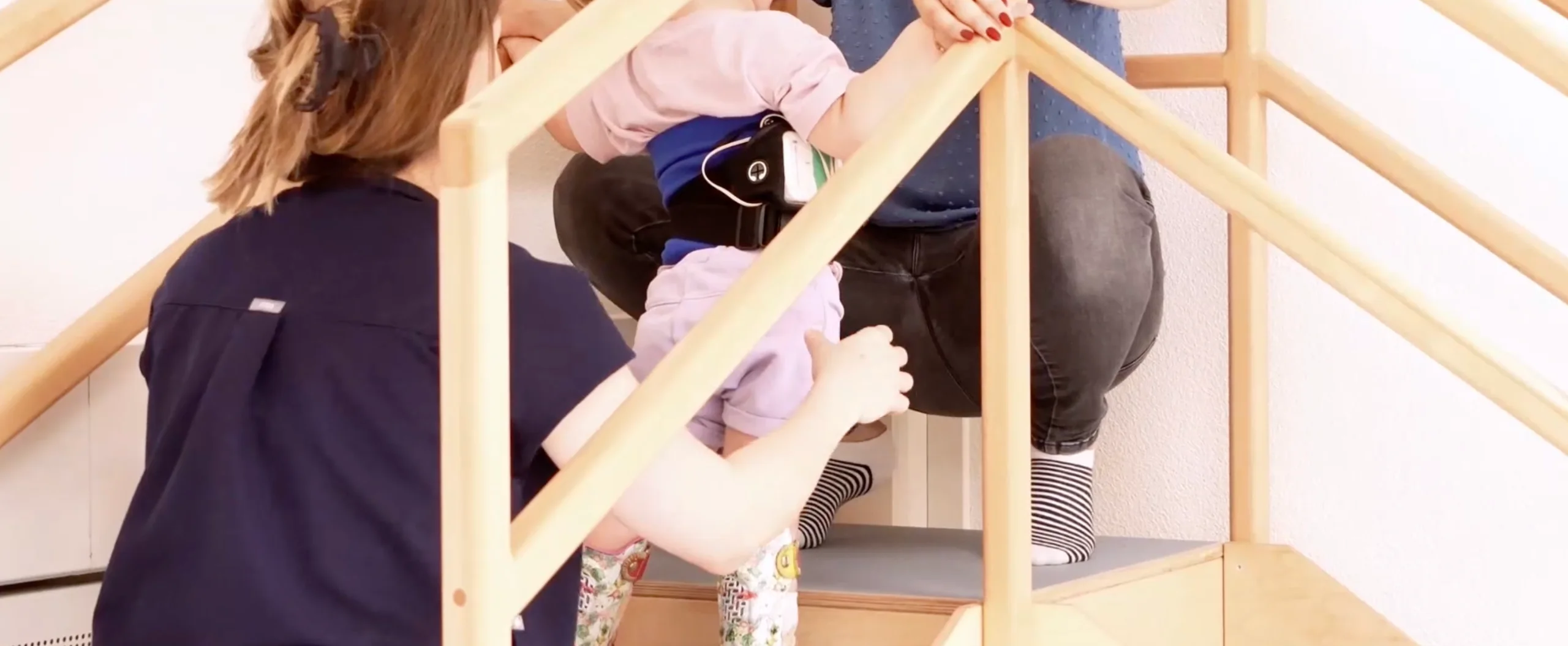
Some parents hear the name of their child’s syndrome on the first day.
Others wait years for an answer, or never get one. Either way, the questions are similar: Will my child sit, stand, walk?
What can we do to help?
This guide gathers what parents most need to know about movement, physiotherapy and rehabilitation in genetic syndromes — plainly and honestly. (Physiotherapy is called physical therapy in some countries.)
What is a genetic syndrome? Genetic disorders explained
A genetic syndrome is a condition caused by a change in a child’s genetic material — their genes or chromosomes.
It is present from birth, often affects several parts of the body, and may be well known, rare or still without a name.
Taken together, genetic disorders are common: Down syndrome alone has a global prevalence of roughly one in every 1,000 births.
Genetic disorders that often affect movement include:
- Down syndrome (Trisomy 21) — usually with low muscle tone and flexible joints;
- Rett syndrome — often with loss of hand skills and changes in walking and balance;
- Angelman syndrome — often with balance and coordination difficulties;
- Prader Willi syndrome — usually with marked low muscle tone in infancy;
- Klinefelter syndrome — boys may have low muscle tone and coordination difficulties;
- Fragile X and Williams-Beuren syndrome — with varying effects on coordination and motor planning;
- genetic neuromuscular conditions such as spinal muscular atrophy and Duchenne or Becker muscular dystrophy;
- rare, complex genetic conditions such as juvenile Huntington’s disease, and undiagnosed syndromes.
A closer look at common syndromes
Down syndrome
Children with Down syndrome usually have low muscle tone, flexible joints and shorter limbs, so gross motor development takes longer.
Physiotherapy focuses on postural stability, core stability, strength and balance training, and on efficient walking patterns rather than “walking at any cost”, because wide, unstable gait habits are hard to change later.
Rett syndrome
Rett syndrome mainly affects girls. After a period of typical development, hand skills and walking ability in Rett syndrome can change, and muscle stiffness, scoliosis and breathing irregularities may appear.
In Rett syndrome, physiotherapy aims to keep the child moving and upright, maintain joint range and walking for as long as possible, and support hand use and promote participation.
Angelman syndrome
Children with Angelman syndrome often have balance and coordination difficulties and a typical stiff-legged, wide-based gait.
Balance training, postural control work and safe, playful practice of independent movement are central.
Prader Willi syndrome and structured exercise programs
Babies with Prader Willi syndrome have very low muscle tone, and later in childhood weight management becomes important. Regular physical activity and structured exercise programs build muscle strength, endurance and functional capacity, and support overall well being.
How genetic conditions affect movement and physical development
Each of these genetic disorders is different, and within a syndrome every child is different again. Common motor challenges are:
- low muscle tone (hypotonia) — the body feels floppy, and holding positions like sitting takes much more effort;
- hypermobile joints — joints that move too easily, which makes stability harder;
- delayed motor milestones — head control, sitting, crawling and walking come later;
- balance and coordination difficulties, and sometimes problems with motor planning;
- in some genetic disorders, muscle stiffness or spasticity, or changes in movement over time — here reducing spasticity’s effect on daily movement becomes part of the plan.
These challenges shape a child’s movement and physical development, but they do not decide it. Important: a delay in milestones does not tell you how far your child can go. It tells you where to start.
Many children with genetic disorders keep developing motor skills for years.
Genetic neuromuscular conditions: spinal muscular atrophy and muscular dystrophy
Progressive muscle weakness: what rehabilitation can do
Some genetic conditions, such as muscular dystrophy, affect the muscles or the nerves that control them, and can cause progressive muscle weakness. Here, physiotherapy aims to build and keep strength, prevent complications and keep children active.
- Spinal muscular atrophy (SMA) — new medicines and gene therapy have changed the outlook; active, well-dosed physiotherapy builds muscle strength and helps children make the most of it.
- Duchenne muscular dystrophy and Becker muscular dystrophy — physiotherapy keeps joint range, prevents contractures, uses safe exercise without overloading, and plans mobility aids early.
- Progressive conditions — in rarer genetic conditions such as juvenile Huntington’s disease, physiotherapy helps manage symptoms and keep function and comfort for as long as possible.
- Breathing and respiratory function — breathing exercises and respiratory therapy when muscular dystrophy or SMA weakens the chest.
Breathing exercises and respiratory function
When muscular dystrophy or SMA weakness reaches the trunk and chest, breathing exercises, airway clearance and good positioning protect respiratory function, sleep and energy for play. Our respiratory therapy, ORCA-Flow, is built on RTA (thoraco-abdominal rebalancing).
In spinal muscular atrophy and muscular dystrophy, the right dose matters as much as the right exercise, so we work closely with your neuromuscular team.
Why early, active physiotherapy matters for gross motor development
A young child’s brain is highly adaptable — this is called neuroplasticity. Movement the child produces themselves, repeated often enough, helps the brain build and strengthen the connections that control posture and movement.
That is why physiotherapy for children with genetic syndromes works best when it is:
- early — ideally in the first months and years;
- active — the child does the work, rather than being moved passively;
- repetition-rich and measured — enough practice to drive change, with progress tracked objectively.
Our early intervention programme is built around this window.
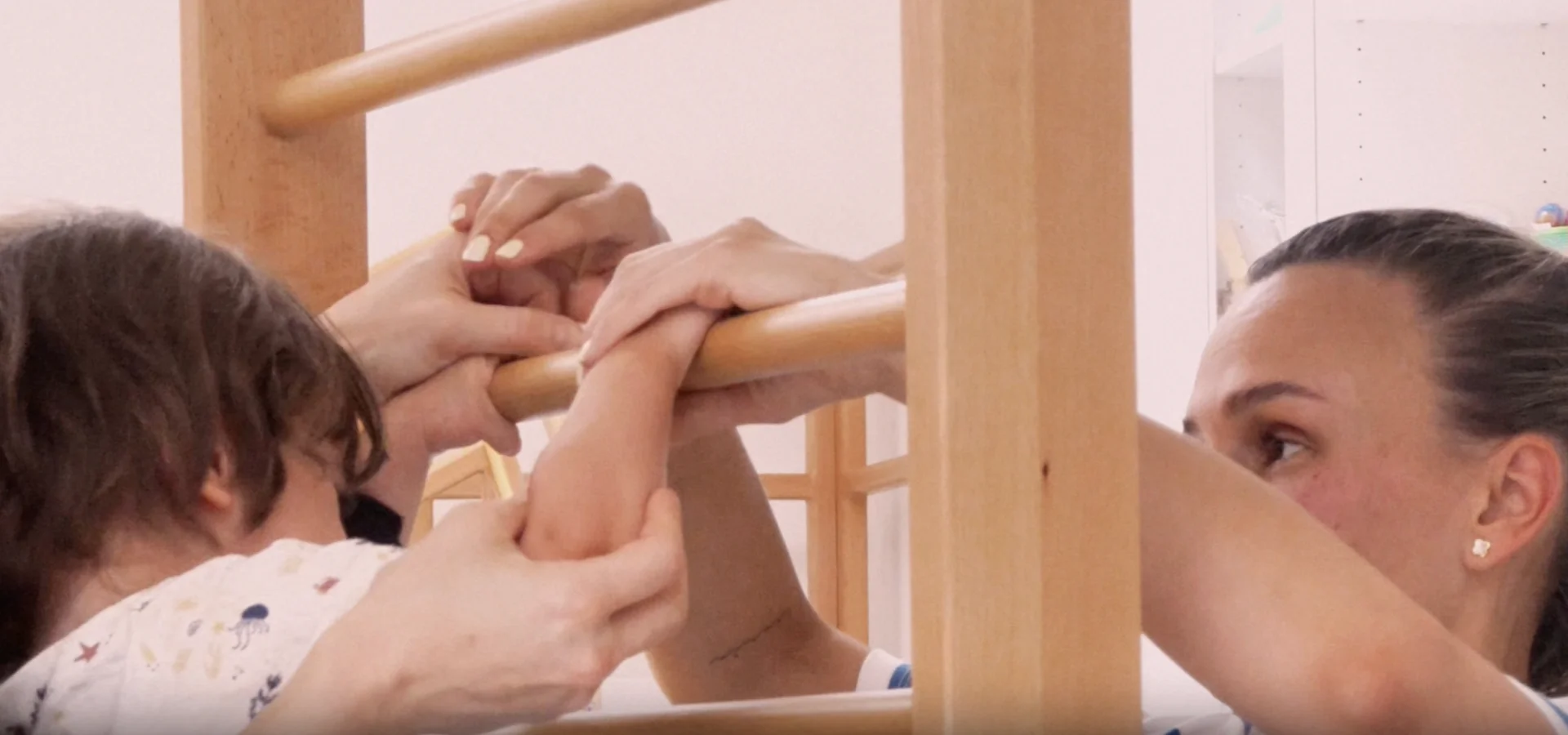
Physiotherapy treatment: postural stability, joint range, strength, balance and mobility aids
Effective physiotherapy treatment usually combines several building blocks, chosen for each child:
- Postural control and core stability — the foundation for sitting, standing and using the hands.
- Muscle strength and exercise training — playful, progressive strengthening that improves motor performance and physical function, especially with hypotonia.
- Hydrotherapy — water lets children move more freely, build endurance and practise skills still hard on land.
- Balance training — to make standing and walking safer and more confident.
- Joint range and alignment — stretching, positioning and wearable support to prevent contractures and protect hypermobile joints.
- Walking practice — including treadmill training, which has been studied in Down syndrome, to improve walking ability and gait speed.
- Assistive devices and mobility aids — standing frames, walkers, orthoses or wheelchairs that support upright posture and independence.
- Physical activity for life — sport, swimming and active play that promote participation and improve quality of life.
Genetic syndromes physiotherapy: what to look for in a children's physiotherapy service
Not every children’s physiotherapy service has experience with genetic syndromes. These questions help:
- Experience with complex genetic conditions — has the team worked with your child’s syndrome or a similar profile?
- Active, not passive — are the physiotherapy interventions built around your child’s own movement, with exercise interventions that challenge them just enough?
- Intensive physiotherapy options — can your child train in concentrated blocks when a push makes sense, not only once a week?
- Measured progress — are significant improvements documented with standardised tests, not just felt?
- Multidisciplinary care — do they coordinate with your doctors, occupational therapist, speech therapist and school?
- Coaching for parents — will you leave knowing how to support your child’s movement at home?
The goal of a good children’s physiotherapy service is always the same: to improve motor performance in ways that matter in daily life, build functional independence and improve quality of life for the whole family.
Modern rehabilitation and physiotherapy: what has changed
Children with genetic conditions used to receive mostly passive exercise and a lot of waiting. Modern, state-of-the-art therapeutic approaches look different:
- Active, task-specific training — real skills such as sitting, standing and stepping, set just above what the child can do alone.
- Higher intensity — concentrated blocks of treatment give far more practice than an occasional session.
- Support that enables movement — suits, suspension, strapping and vibration help children train upright safely.
- Objective measurement — standardised outcome measures show changes in motor skills and functional outcomes as your child grows.
- A multidisciplinary approach — physiotherapy interventions, occupational therapy, speech therapy and medical specialists working to the same goals.
- Family-centred care — parents play a key role in the team, and remote sessions keep progress going at home.
What rehabilitation looks like at Apexa QLA Suisse
We are a specialist centre for complex neuro-motor cases. Children with Down syndrome, rare genetic disorders and genetic conditions without a name come to us from many countries, often after other physiotherapy has stalled.
Complex and rare cases are our focus, not the exception.
We don’t treat a label — we treat a child. Every plan is built with the ORCA Method (Objective Reasoning & Clinical Architecture), created by our lead therapist Fabienne Theler, MSc PT, around your child’s exact tone, strengths and goals.
Depending on your child, we combine:
- DMI (Dynamic Movement Intervention) — exercises against gravity that provoke automatic responses and build new motor skills step by step, used in Down syndrome and rarer genetic disorders such as Rett syndrome, Angelman and Prader-Willi syndromes. Repeated often enough, these responses strengthen connections in the brain — neuroplasticity — so a new skill gradually becomes automatic.
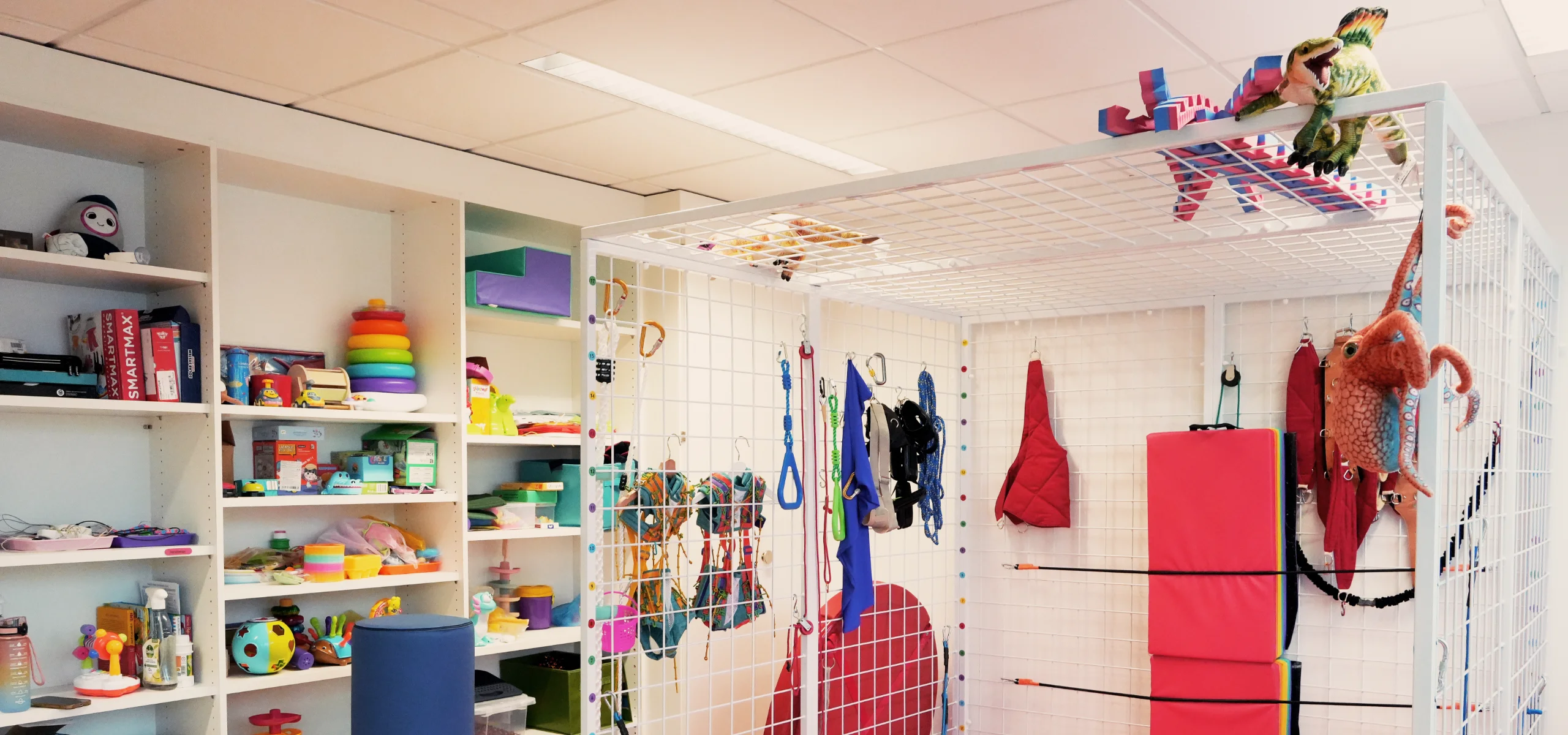
- Suit therapy and the Spidercage — elastic support and suspension for safe, intensive practice of standing and stepping.
- Galileo vibration and NISE-Stim — to activate muscles and support tone.
- ORCA-Flow — respiratory therapy for breathing and respiratory function, important in muscular dystrophy, SMA and many genetic conditions.
- TheraTogs — soft wearable support for alignment, joint stability and body awareness through the day, especially helpful with low muscle tone and hypermobile joints. We are the TheraTogs experts: our certified TheraTogs fitters are recognised worldwide and were trained by the inventor of TheraTogs, Beverly (Billy) Cusick. We also train and certify other professionals.
Children come for weekly sessions or for ORCA Intensives of one to four weeks. We measure before and after with recognised tools such as the GMFM and Peabody scales, and we re-measure as your child grows.
Measuring what matters: GMFM, Peabody-3 and the ICF-CY
We measure with internationally recognised tools.
The GMFM (Gross Motor Function Measure) tracks gross motor skills such as lying and rolling, sitting, crawling, standing, walking, running and jumping. It is one of the most widely used outcome measures in paediatric physiotherapy and rehabilitation (Russell et al., 1989).
The Peabody Developmental Motor Scales, third edition (Peabody-3) assess gross and fine motor development in young children, so we can see how your child’s skills compare with typical development and how they change over time (Folio & Fewell, 2023).
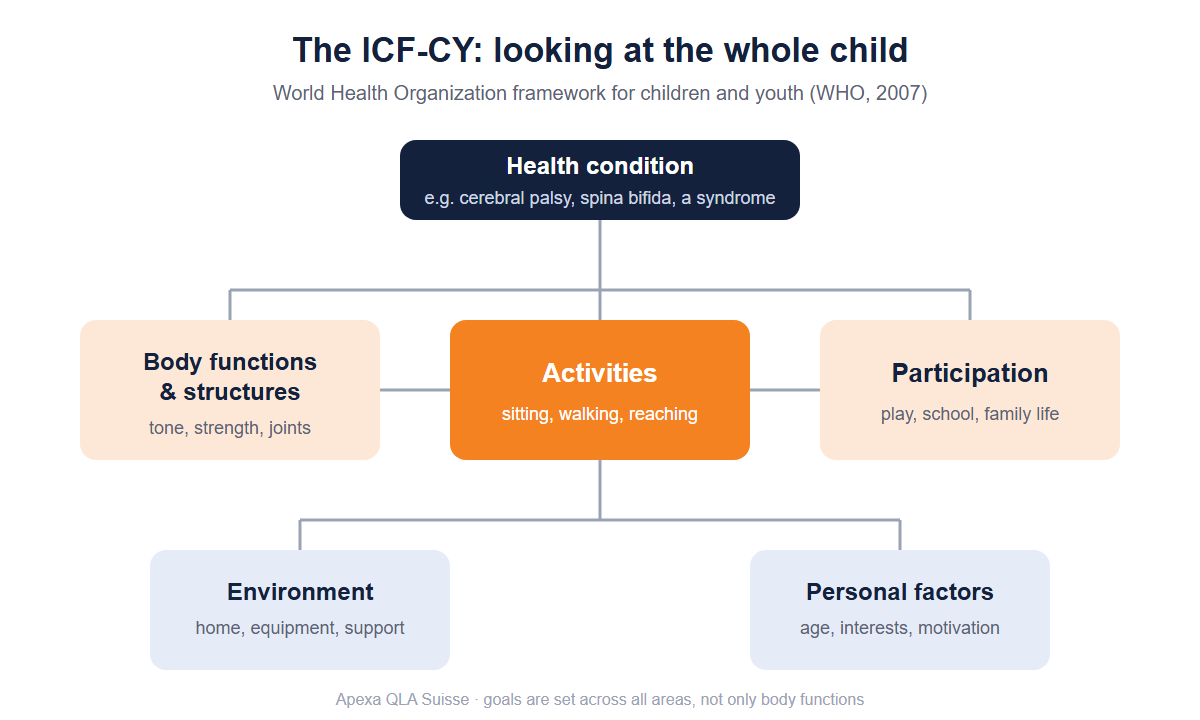
We plan with the ICF-CY — the World Health Organization’s International Classification of Functioning, Disability and Health for Children and Youth (WHO, 2007).
It looks beyond the diagnosis at four areas together: body functions and structures, activities, participation in daily life, and the environment around your child. That is how we make sure physiotherapy goals are goals that matter at home, at nursery and at school.
Beyond physiotherapy: parent enablement and case management
Parent enablement. In our ORCA Enablement blocks we coach parents to become confident co-therapists, so your family becomes more independent and progress continues at home between visits.
Medical case management. If you wish, we also act as your child’s medical case manager — coordinating reports, appointments and communication with your doctors, specialists and therapists, so you have one point of contact.
Your family portal: a direct line to the team
Every family gets access to our family portal at fam.apexaqla.ch — your direct line to the team at all times. In the portal you can speak to your therapists, upload videos of your child at home so we can give feedback, find your child’s reports and progress measurements, see invoices and financial information, read articles about therapy, and much more.
What the research says
Research on physiotherapy, rehabilitation and intensive therapy in genetic conditions is growing, but many genetic conditions are rare, so large trials, systematic reviews and meta analyses are often impossible, and future studies are needed.
We are honest about that. A case report shows what is possible, a randomised trial tests whether a therapy works, and a systematic review — based on a comprehensive literature search and reported to standards such as PRISMA (Preferred Reporting Items for Systematic Reviews and Meta-Analyses) — combines all trials on one question. What the evidence does support is that physiotherapy and rehabilitation should be active, goal-directed and based on the best available research (Veras et al., 2016).
The three pillars of evidence-based practice. Good rehabilitation rests on the best available research evidence, clinical expertise to apply it to one particular child, and the values, goals and preferences of the child and family — all three together (Veras et al., 2016).
For DMI, a small case series from Johns Hopkins Hospital, presented at the MDA Clinical & Scientific Conference, described two children with spinal muscular atrophy type 1 — a genetic neuromuscular condition — who received DMI after gene replacement therapy. Both tolerated the therapy and gained motor skills and milestones, measured with the CHOP-INTEND and WHO motor milestone scales (Vela, 2023).
Case series show what is possible, not what every child will achieve — that is why we measure every child’s progress ourselves.
In Down syndrome, one of the best-known early studies showed that infants who practised stepping on a small treadmill at home, supported by their parents, learned to walk independently several months earlier than infants who did not (Ulrich et al., 2001).
What progress can we expect?
We do not promise outcomes. The syndrome, your child’s health and motor function all shape what is possible.
Children keep gaining skills when physiotherapy interventions are active, intensive enough and built around them.
A careful assessment is the right starting point.
Quality of life and financial support for families
Physiotherapy is not only about milestones. Good rehabilitation also protects your child’s comfort, sleep, breathing and joy in moving — their quality of life and well being in daily life.
Ask your doctors and insurer about financial support for treatment, equipment and travel; rules differ between countries and genetic conditions.
Questions parents often ask
My child has a rare or undiagnosed syndrome. Can you still help?
Yes. We work with complex and rare cases every day.
We plan treatment around what your child can do and needs to learn, not around a name.
Will my child with a genetic syndrome learn to walk?
Many children do, sometimes later than their peers. It depends on the genetic condition and on the individual child.
Active, measured physical therapy gives your child the best chance to reach their next milestone, whatever it is.
Do you work with families from outside Switzerland?
Yes. Families travel from all over the world — including from across Europe and the Balkans — to Zug for modern therapies and the latest advances in paediatric rehabilitation, often for intensive blocks, and we offer teletherapy between visits.
When should physiotherapy start for a child with a genetic syndrome?
As early as possible — ideally in the first months and years, while the developing brain is most adaptable.
But it is never too late: many children with genetic conditions keep progressing in gross motor development for years.
Is intensive physiotherapy suitable for children with Down syndrome?
It can be, when the plan is built around your child’s tone, health and goals. Physiotherapy focuses on postural stability, core strength, balance and efficient walking patterns, because wide, unstable gait habits are hard to change later.
We measure before and after, so you can see what changes.
Is exercise safe for children with SMA or muscular dystrophy?
It can be, when the dose is right. In SMA and Duchenne muscular dystrophy, safe and regular exercise that avoids exhaustion and heavy overloading matters as much as the exercise itself.
We work closely with your neuromuscular team and adapt every session to your child.
How long is an ORCA Intensive?
An ORCA Intensive lasts one to four weeks, with several hours of active treatment a day, paced with rest and play.
We recommend the length after a free introductory call and an assessment. Between blocks, weekly 50-minute sessions or virtual visits keep progress going.
What does an intensive cost?
Costs depend on the length and content of the block, so there is no single price.
You will find our current prices on the costs and fees page, and we are transparent about costs from the very start.
Will health insurance pay for therapy?
That depends on your country, your insurer and your child’s condition, so we cannot promise coverage.
We provide detailed reports and progress measurements that you can share with your doctors and your insurer. It is worth asking your insurer before you book.
Next step: talk to us
If you would like to know how modern rehabilitation could help your child, book a free introductory call through our contact page, or read more about how we work with genetic syndromes.
References
- Vela, K. (2023). Dynamic Movement Intervention in children with spinal muscular atrophy type 1 with gene replacement therapy to gain motor milestones: A case series [Poster]. MDA Clinical & Scientific Conference. mdaconference.org
- Ulrich, D. A., Ulrich, B. D., Angulo-Kinzler, R. M., & Yun, J. (2001). Treadmill training of infants with Down syndrome: Evidence-based developmental outcomes. Pediatrics, 108(5), e84. doi.org/10.1542/peds.108.5.e84
- Veras, M., Kairy, D., & Paquet, N. (2016). What is evidence-based physiotherapy? Physiotherapy Canada, 68(2), 95. doi.org/10.3138/ptc.68.2.gee
- Folio, M. R., & Fewell, R. R. (2023). Peabody Developmental Motor Scales (3rd ed.). Pro-Ed.
- Russell, D. J., Rosenbaum, P. L., Cadman, D. T., Gowland, C., Hardy, S., & Jarvis, S. (1989). The gross motor function measure: A means to evaluate the effects of physical therapy. Developmental Medicine & Child Neurology, 31(3), 341–352. doi.org/10.1111/j.1469-8749.1989.tb04003.x
- World Health Organization. (2007). International Classification of Functioning, Disability and Health: Children and Youth Version (ICF-CY). WHO.
This article is general information and does not replace a medical assessment. Clinical content on this website is reviewed by Fabienne Theler, MSc PT.