English
 Deutsch
 Español
 Français
 Italiano
 Nederlands
 العربية
 中文 (中国)
 Dansk
 Svenska
 Norsk
 Suomi
 日本語
 Polski


Parent guides
Spina bifida in children: types, treatment and modern rehabilitation for mobility and independence
What spina bifida is, how it is diagnosed and treated, how it affects movement at every level — and how early, active rehabilitation — including spina bifida physiotherapy — helps children build strength, protect their joints and become as independent as possible.
If your child has spina bifida, you have probably already met a long list of health professionals — neurosurgeons, urologists, orthopaedic surgeons. Rehabilitation is one more name on that list, but it is the part of care you will see most often as your child grows. This guide gathers what parents most need to know about managing spina bifida, plainly and honestly, with a special focus on movement and rehabilitation for children born with this condition.
What is spina bifida?
Spina bifida is a condition present from birth in which the spinal column and the spinal cord do not form completely. It happens in the first weeks of pregnancy, when the neural tube — the structure that becomes the brain and spinal cord — does not close fully. That is why spina bifida is called a neural tube defect, and why it belongs to the neurological disorders that babies born with it carry for life: the bones of the baby’s spine do not close around the cord. It is rare — in Europe, neural tube defects affect roughly one in every 1,000 pregnancies or fewer. Where the spinal canal stays open, the spinal cord and spinal nerves can be damaged, which affects the child’s nervous system below that point.
Types of spina bifida
Doctors describe three main spina bifida types. They differ a great deal in how much they affect a child’s nervous system:
- Spina bifida occulta (“hidden” spina bifida, also called occult spinal dysraphism) — a small gap in one or more vertebrae, covered by skin. It is usually harmless, and many people never know they have it. Sometimes a dimple, hair tuft or birthmark over the lower back is the only sign, and an imaging test is needed to check the spinal cord.
- Meningocele — a fluid filled sac pushes through the gap in the spine. The spinal cord itself is usually not damaged, so symptoms are often mild.
- Myelomeningocele — the most severe form of open spina bifida, in which part of the spinal cord and nerves are exposed. This is usually what doctors mean when they say “spina bifida”. Spina bifida myelomeningocele can lead to paralysis of the legs (paraplegia) and to a neurogenic bladder and bowel, and it is the form this guide mostly talks about.
Causes and risk factors
Doctors do not know exactly why spina bifida occurs in a particular baby. It is likely a mix of genetic and environmental factors. Known risk factors include:
- not having enough folic acid before and in early pregnancy;
- some medicines taken in pregnancy, especially valproic acid (used for epilepsy);
- diabetes or obesity in the mother;
- a previous pregnancy affected by a neural tube defect, or a family history.
To help prevent spina bifida, health authorities recommend that all women of childbearing age who could become pregnant take a daily folic acid supplement, usually 400 micrograms, from before conception until about the twelfth week of pregnancy. This is the advice of the US Centers for Disease Control and Prevention and, in the UK, of the National Institute for Health and Care Excellence; your healthcare provider may recommend a higher dose if you have had an affected pregnancy before. But please hear this clearly: when spina bifida happens, it is not something you caused.
Diagnosis before and after birth
Many babies with spina bifida are now diagnosed before birth. Prenatal diagnosis usually comes from the routine ultrasound scan in the middle of pregnancy, sometimes after a blood test (alpha-fetoprotein) has shown a raised level. A detailed scan or fetal MRI then shows the level and type. After birth, open spina bifida is visible, and imaging of the brain and spine guides the treatment plan.
Medical treatment: surgery and beyond
Spina bifida surgery closes the opening in the back to protect the spinal cord and prevent infection. It is usually done within the first days after birth. In some specialised centres, selected babies can have the repair before birth (fetal surgery), which in some children reduces the need for a shunt and helps leg function.
Spina bifida affects more than the legs, so most children are followed by a team — many pediatric clinics run a dedicated spina bifida clinic, often with doctors in physical medicine and rehabilitation, who help manage symptoms and plan care around the child’s condition:
- Hydrocephalus — many babies with myelomeningocele build up fluid in the baby’s brain. Without treatment, the rising pressure can cause brain injury. Doctors treat hydrocephalus with a shunt (a thin tube that drains the fluid) or a small operation called endoscopic third ventriculostomy.
- Bladder and bowel function — the nerves to the bladder and bowel are often affected. Many children use clean intermittent catheterisation and a bowel programme that makes bowel movements regular and predictable; bowel and bladder problems and urinary tract infections need regular follow-up.
- Orthopaedic care — muscle weakness and imbalance can lead to hip dislocation, foot deformities and scoliosis (a curved spine) as the child grows. Less weight-bearing can also lower bone density, so bone problems such as fractures need watching.
- Learning and attention — some children, especially those with hydrocephalus, have learning disabilities or attention difficulties and need extra support at school.
- Latex allergy — children with spina bifida have a higher risk of latex allergy, so latex-free materials are used whenever possible.
Important: if your child suddenly loses skills, develops new weakness, back pain, a change in walking or bladder control, or shows signs of a blocked shunt (headache, vomiting, unusual sleepiness), contact your medical team straight away. A tethered spinal cord — where the cord is pulled as the child grows — or a shunt problem needs prompt medical attention, and a tethered cord sometimes needs surgery to release it.
How spina bifida affects movement
The symptoms of spina bifida that affect movement depend mainly on the level of the spine that is involved. Below that level, the spinal nerves that control muscle function and sensation may work only partly or not at all, so mobility problems and altered sensation go together:
- Thoracic level (upper back) — the legs are usually not under active control; children often use a wheelchair and may stand with the help of supports.
- Lumbar level (lower back) — some hip and knee muscles work; many children walk with orthoses — often knee ankle foot orthoses (KAFOs) at higher lumbar levels — and sometimes crutches or a walker, and use a wheelchair for longer distances.
- Sacral level (bottom of the spine) — most leg muscles work; many children walk independently, sometimes with ankle orthoses.
Reduced sensation in the skin, muscle weakness and joint problems are why a good rehabilitation plan always looks at the whole child — not just the legs.
Spina bifida rehabilitation: what it aims to do
For children with spina bifida, early and consistent active rehabilitation pays off for years. Physiotherapy is at its heart, often together with occupational therapy and orthotics. Rehabilitation aims to:
- build strength and control in every muscle that works — at and below the level;
- protect range and alignment in the hips, knees and feet, so contractures and deformities are less likely;
- support upright function — sitting balance, standing and, where possible, walking — which also helps bone health, bone density and digestion;
- develop mobility and independence, from rolling and crawling to walking, transfers or confident wheelchair skills;
- protect the skin by teaching pressure relief and safe positioning where sensation is reduced;
- support normal development in play, so movement helps your child explore, learn and join in with everyday life.
What that looks like in practice
- Postural management from infancy — guiding how your baby is positioned and carried, so hips, knees and feet develop in good alignment and contractures are prevented.
- Handling for parents — we show you how to lift, carry and position your child safely, protecting skin with reduced sensation and avoiding injury.
- Range-of-motion work and stretching — regular, gentle movement of the joints to keep them supple, especially during growth spurts.
- Strengthening and endurance training — building every working muscle, from the trunk to the hips, to offset weakness and make daily activities less tiring.
- Gait training — for children with the potential to walk, practising efficient walking patterns that save energy and avoid strain.
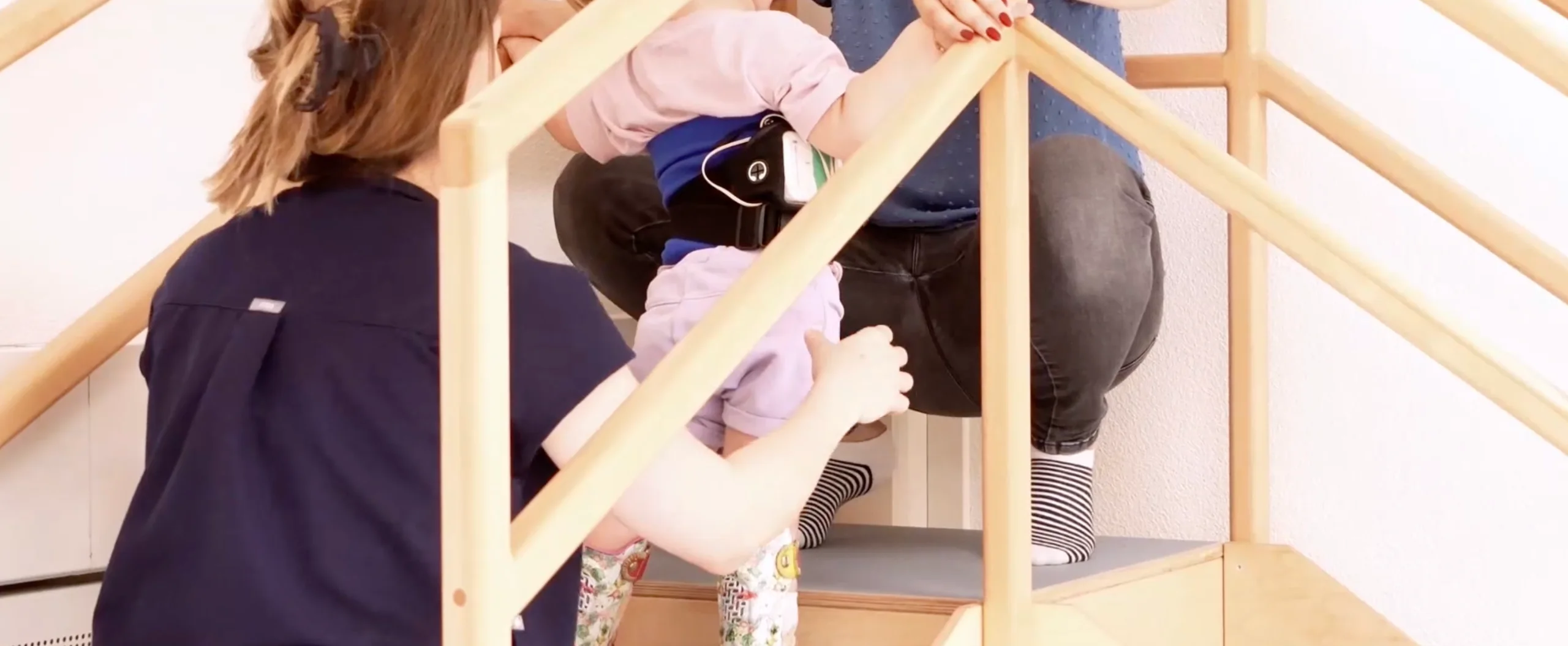
- Assistive devices — assessing and fitting orthoses, standing frames, walkers or wheelchairs together with your orthotist, so the right equipment supports — rather than limits — your child.
Modern rehabilitation: what has changed
Paediatric neurorehabilitation has changed a great deal in the last two decades. Instead of mostly passive stretching and waiting, modern rehabilitation is built on a few clear principles:
- Active, task-specific training — the child practises real skills such as sitting, standing, transfers and stepping, because that is what the nervous system learns from.
- Higher intensity — concentrated blocks of therapy deliver far more practice than an occasional session.
- Neuromodulation — non-invasive stimulation of the spinal cord and muscles is an active field of research for children with spinal cord conditions, and task-specific electrical stimulation pairs impulses with movement.
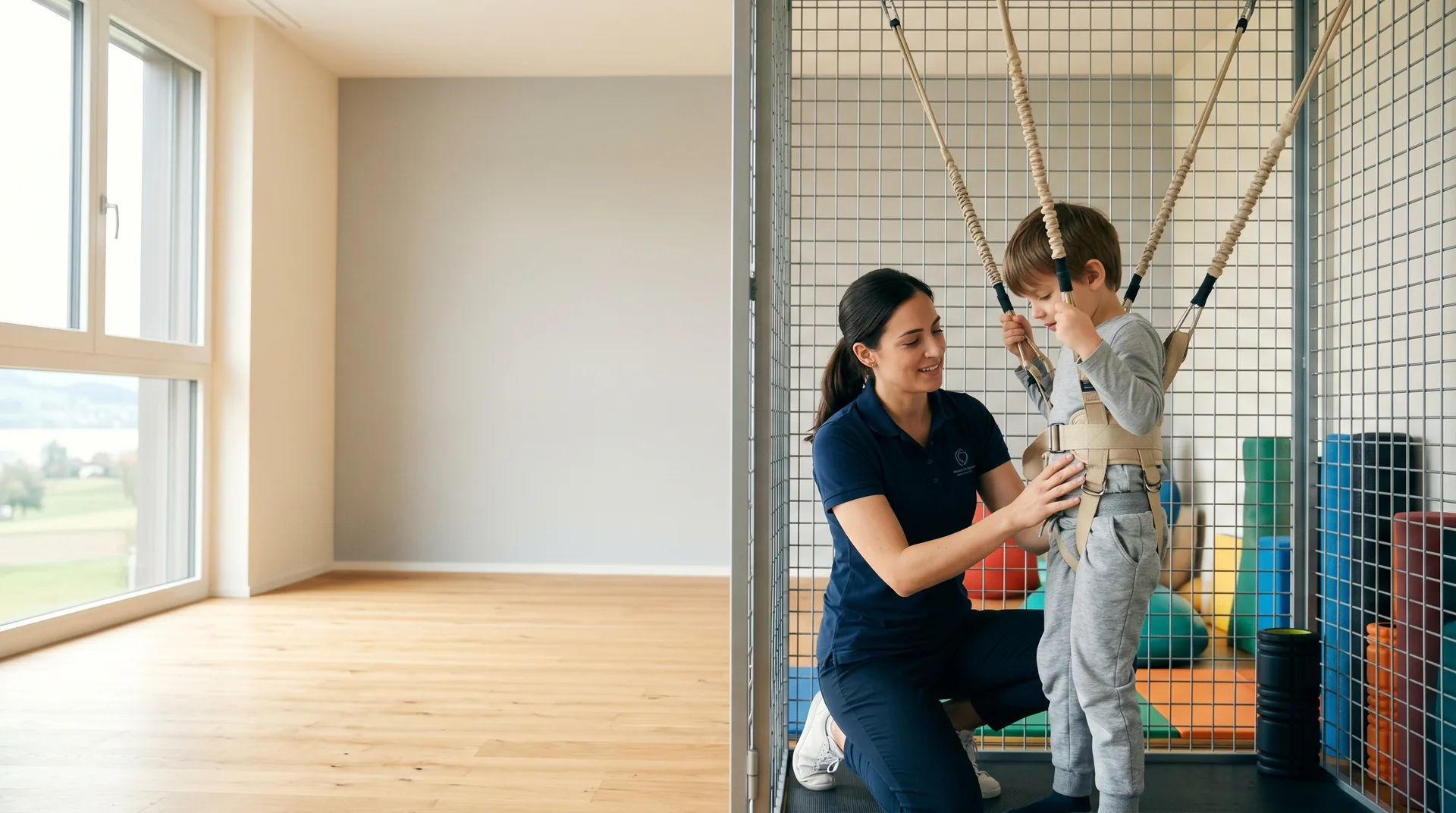
- Body-weight support and suspension — suits and suspension systems let children train upright safely long before they could do it alone.
- Objective measurement — standardised tests make progress visible and guide every next step.
- Family-centred and tele-rehabilitation — parents are coached as part of the team, and remote sessions keep progress going at home.
Where evidence suggests a clear benefit we say so; some approaches are well established, others are still emerging, and we tell you honestly which is which.
What rehabilitation looks like at Apexa QLA Suisse
We are a specialist centre for complex neuro-motor cases, and spina bifida is part of our daily work. Our team has years of hands-on experience with children at every level of spina bifida, with the postural and orthopaedic health issues that often come with it, and with rare presentations that do not fit neatly into any category. Complex cases are our focus, not the exception. We do not treat a label — we treat a child. Every plan is built with the ORCA Method (Objective Reasoning & Clinical Architecture), created by our lead therapist Fabienne Theler, MSc PT, around your child’s level, strengths and goals. Depending on your child, it can combine:
- DMI (Dynamic Movement Intervention) — exercises against gravity that provoke automatic responses and build trunk control, balance and new movement strategies. Each exercise asks the nervous system for a response it cannot yet make easily. This uses neuroplasticity — the ability of the brain and nervous system to form and strengthen connections through active, repeated practice. A damaged spinal cord does not heal, but neuroplasticity helps a child make the most of every pathway that still works, so new movement strategies become their own.
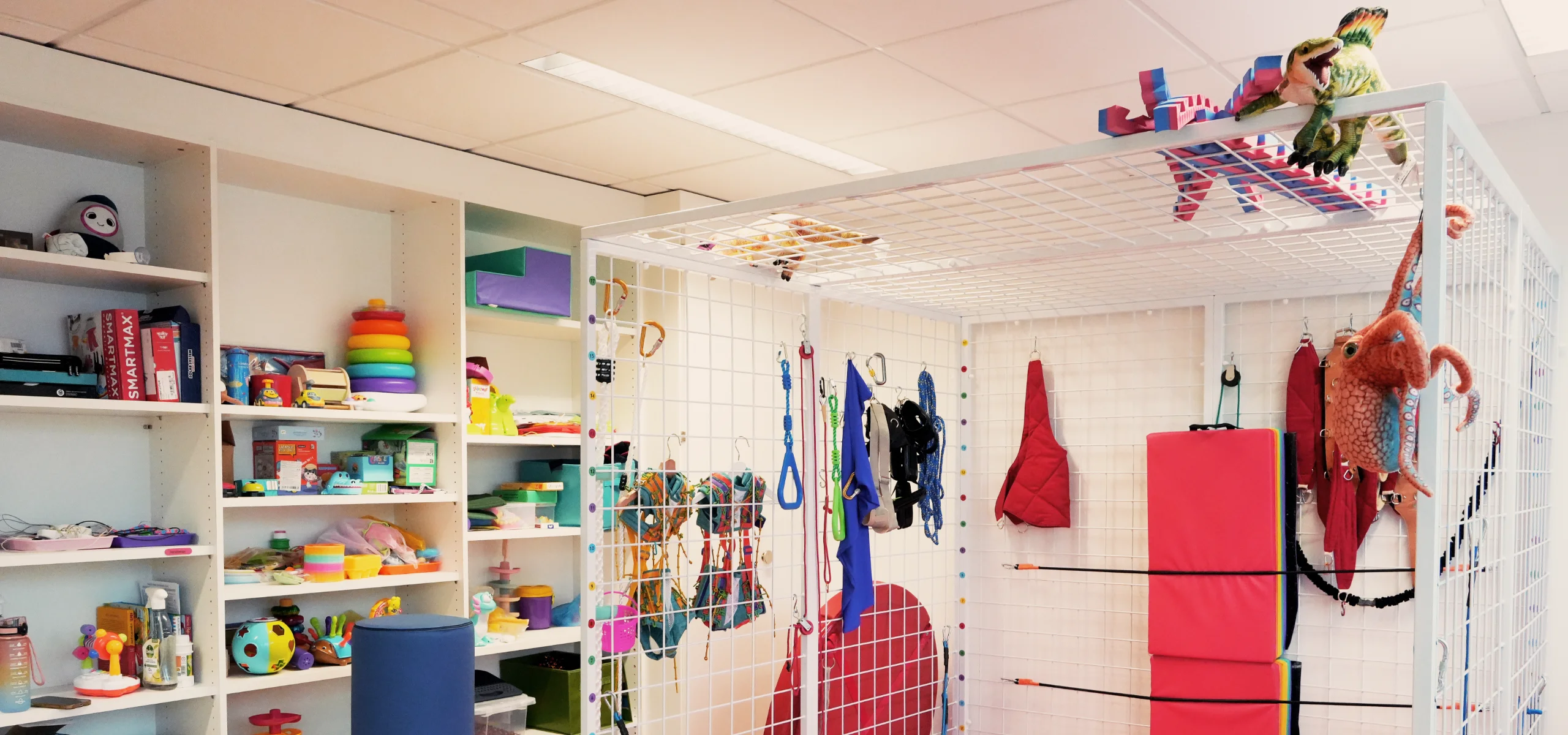
- Suit therapy and the Spidercage — elastic support and suspension that let children practise standing and stepping safely.
- Galileo side-alternating vibration — rhythmic muscle activation that is gentle on the joints, often used to prime active work.
- NISE-Stim — non-invasive spinal and muscle stimulation, which parents can be trained to continue at home where appropriate.
- TheraTogs and orthotic advice — to support alignment through the day, together with your orthotist and our certified TheraTogs experts. We are the TheraTogs experts: our certified TheraTogs fitters are recognised worldwide and were trained by the inventor of TheraTogs, Beverly (Billy) Cusick. They assess, size and fit every system, and we train and certify other professionals too.
Children come for weekly sessions or for ORCA Intensives of one to four weeks, with several hours of active therapy a day. We measure before and after with recognised tools such as the GMFM and Peabody scales, use latex-free materials, and coordinate with your doctors, urology team and orthotist so everyone works towards the same goals.
Measuring what matters: GMFM, Peabody-3 and the ICF-CY
We measure with internationally recognised tools. The GMFM (Gross Motor Function Measure) tracks gross motor skills such as lying and rolling, sitting, crawling, standing, walking, running and jumping. It is one of the most widely used outcome measures in paediatric rehabilitation (Russell et al., 1989).
The Peabody Developmental Motor Scales, third edition (Peabody-3) assess gross and fine motor development in young children, so we can see how your child’s skills compare with typical development and how they change over time (Folio & Fewell, 2023).
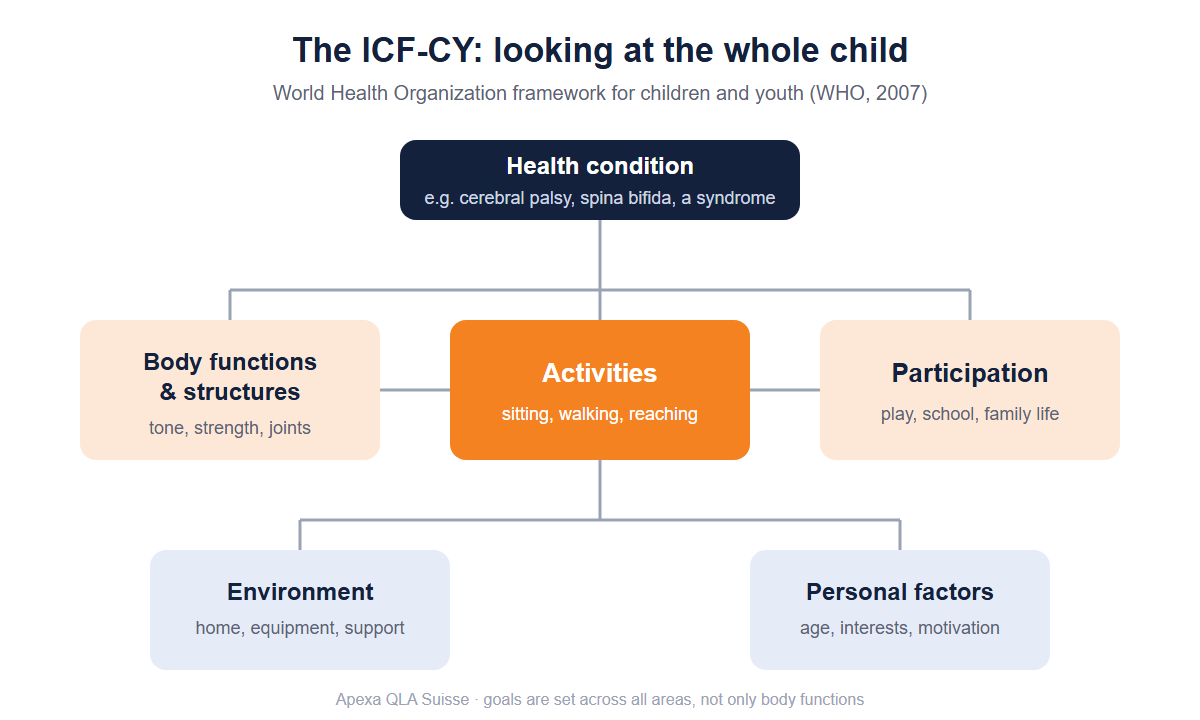
We plan with the ICF-CY — the World Health Organization’s International Classification of Functioning, Disability and Health for Children and Youth (WHO, 2007). It looks beyond the diagnosis at four areas together: body functions and structures, activities, participation in daily life, and the environment around your child. That is how we make sure therapy goals are goals that matter at home, at nursery and at school.
Beyond therapy: parent enablement and case management
Parent enablement. In our ORCA Enablement blocks we coach parents to become confident co-therapists, so your family becomes more independent and progress continues at home between visits.
Medical case management. If you wish, we also act as your child’s medical case manager — coordinating reports, appointments and communication with your doctors, specialists and therapists, so you have one point of contact.
Your family portal: a direct line to the team
Every family gets access to our family portal at fam.apexaqla.ch — your direct line to the team at all times. In the portal you can speak to your therapists, upload videos of your child at home so we can give feedback, find your child’s reports and progress measurements, see invoices and financial information, read articles about therapy, and much more.
What the research says
Research on rehabilitation and intensive therapy in spina bifida is still smaller than for conditions like cerebral palsy, so we are careful about what we claim. What is well supported is that active, goal-directed rehabilitation based on the best available evidence is the standard of good care (Veras et al., 2016). For electrical stimulation, a published case report describes an exploratory stimulation protocol in an infant with spina bifida, developed by Gerti Motavalli together with Dr Gad Alon — the team behind NISE-Stim (Motavalli, McElroy & Alon, 2019). A single case cannot prove that a method works for every child, but it shows how carefully such protocols are being studied, and why we use them only as part of a measured plan.
The three pillars of evidence-based practice. Good rehabilitation rests on three pillars that work together: the best available research evidence; clinical expertise — experienced therapists who know how to apply that research to one particular child; and the values, goals and preferences of the child and family. Research alone cannot tell us what is right for your child, and neither can experience or opinion alone. Evidence-based care brings all three together (Veras et al., 2016).
As your child grows
Babies and toddlers
The first years are about head and trunk control, rolling, sitting and early weight-bearing — and about giving your child the experience of moving through the world. Early, playful active work builds foundations that last.
School-age children
As the child grows, goals shift towards walking endurance, transfers, wheelchair skills, sport and keeping up with friends. Growth spurts can change alignment quickly — and can unmask a tethered cord — so regular reassessment matters.
Teenagers
Independence becomes the main goal: managing their own body and bladder and bowel care, staying active and strong, and preventing secondary problems such as weight gain, pressure sores or back pain.
What progress can we expect?
We will not promise outcomes we cannot evidence. The level of the spina bifida sets important limits, and we are honest about them. Within those limits, many children gain strength, stability and independence they did not have before — and every gain in daily life counts. A careful assessment is the right starting point for realistic goals.
Support for families
You do not have to find your way alone. National spina bifida associations offer advice, family events and contact with other parents — in Switzerland, SBH Schweiz, and across Europe, the member organisations of the International Federation for Spina Bifida and Hydrocephalus (IF). Talking to parents who have walked the same road can be one of the most helpful things of all.
Questions parents often ask
Will my child with spina bifida be able to walk?
It depends mainly on the level of the spina bifida and on muscle strength. Many children with lumbar or sacral level spina bifida walk, often with orthoses. Children with higher levels may stand with support and use a wheelchair for mobility — and a confident wheelchair user is independent too.
When should spina bifida physiotherapy start?
As early as your medical team allows, usually in the first months of life. But it is never too late: older children and teenagers can still build strength and skills.
Is intensive therapy safe for children with a shunt?
It can be, when it is planned with your child’s medical history in mind. We ask about shunts, surgeries and latex allergy before we start, and adapt every exercise to your child.
Can spina bifida be prevented?
The risk can be lowered — mainly by taking folic acid before and in early pregnancy — but not every case can be prevented.
Do you work with families from outside Switzerland?
Yes. Families travel from all over the world — including from across Europe and the Balkans — to Zug for modern therapies and the latest advances in paediatric rehabilitation, often for intensive blocks, and teletherapy supports you at home between visits. Our concierge helps with travel and accommodation.
Can children with spina bifida play sport?
Yes — and staying active is good for strength, bone health, weight and confidence. Many children with spina bifida enjoy swimming, adapted sports and wheelchair sports alongside their friends. Check new activities with your medical team, protect skin where sensation is reduced, and look out for bumps or pressure marks your child may not feel.
Does my child need surgery for a tethered cord?
Not always. Many children with spina bifida show some tethering on scans without any problems; surgery to release the cord is considered when there are signs such as new weakness, back or leg pain, a change in walking, worsening scoliosis or changes in bladder control. That decision belongs to your neurosurgeon. Regular reassessment in therapy, especially during growth spurts, helps spot changes early so you can contact your medical team straight away.
How long is an ORCA Intensive?
An ORCA Intensive lasts one to four weeks, with several hours of active therapy a day, paced with rest and play. We recommend the length after a free introductory call and an assessment, based on your child’s age, energy and goals. Between blocks, weekly 50-minute sessions or virtual visits keep progress going.
What does an intensive cost?
Costs depend on the length and content of the block, so there is no single price. You will find our current prices on the costs and fees page, and we are transparent about costs from the very start.
Will health insurance pay for therapy?
That depends on your country, your insurer and your child’s situation, so we cannot promise coverage. We provide detailed reports and progress measurements that you can share with your doctors and your insurer. It is worth asking your insurer before you book, so you know what to expect.
Next step: talk to us
If you would like to know what modern rehabilitation could do for your child, book a free introductory call through our contact page, or read how we work with spina bifida.
References
- Motavalli, G., McElroy, J. J., & Alon, G. (2019). An exploratory electrical stimulation protocol in the management of an infant with spina bifida: A case report. Child Neurology Open, 6. doi.org/10.1177/2329048X19835656
- Veras, M., Kairy, D., & Paquet, N. (2016). What is evidence-based physiotherapy? Physiotherapy Canada, 68(2), 95. doi.org/10.3138/ptc.68.2.gee
- Folio, M. R., & Fewell, R. R. (2023). Peabody Developmental Motor Scales (3rd ed.). Pro-Ed.
- Russell, D. J., Rosenbaum, P. L., Cadman, D. T., Gowland, C., Hardy, S., & Jarvis, S. (1989). The gross motor function measure: A means to evaluate the effects of physical therapy. Developmental Medicine & Child Neurology, 31(3), 341–352. doi.org/10.1111/j.1469-8749.1989.tb04003.x
- World Health Organization. (2007). International Classification of Functioning, Disability and Health: Children and Youth Version (ICF-CY). WHO.
This article is general information and does not replace a medical assessment. Clinical content on this website is reviewed by Fabienne Theler, MSc PT.