English
 Deutsch
 Español
 Français
 Italiano
 Nederlands
 العربية
 中文 (中国)
 Dansk
 Svenska
 Norsk
 Suomi
 日本語
 Polski

Methodology
The 2026 guide to ORCA Intensives
Everything parents ask before their first immersive block — the assessment, how each child’s day is built from 50-minute therapy units, the tools we use, how QLA Labs diagnostics and our team analysis shape the plan, what the ORCA report contains, and what the research says about intensive rehabilitation.
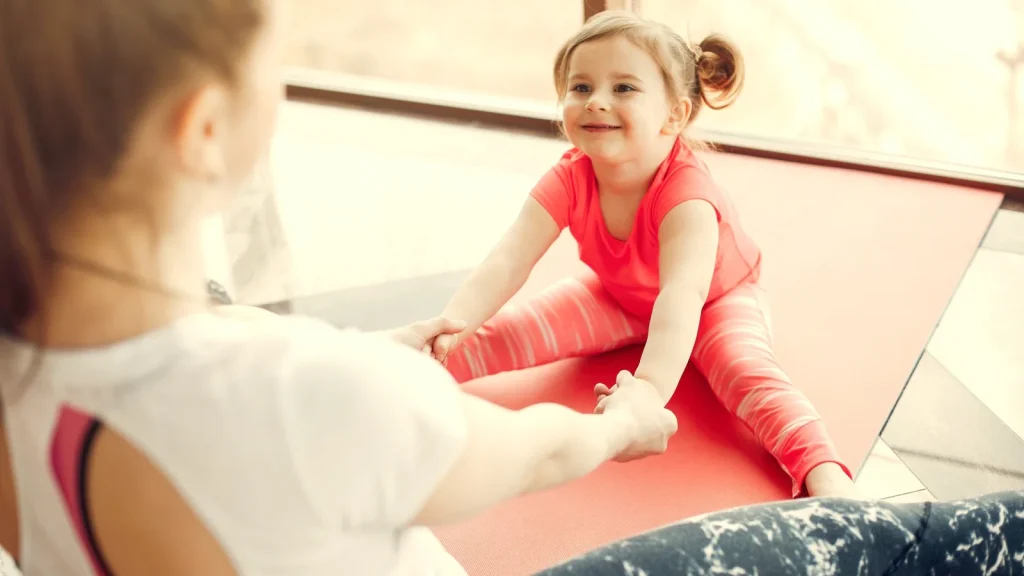
If your child has been offered an ORCA Intensive, you probably have more questions than answers. An intensive isn’t a longer version of weekly therapy — it’s a focused, immersive block built around one idea: that concentrated, active practice can unlock progress that spread-out sessions rarely reach. Here’s what that really means for your family, from the first assessment to the report you take home.
What an ORCA Intensive actually is
An ORCA Intensive is a one- to four-week block of daily, high-repetition active therapy, wrapped in the wider ORCA framework — Objective Reasoning & Clinical Architecture, created by our lead therapist Fabienne Theler, MSc PT. Instead of one session a week, your child works in structured daily sessions, each one building on the last while the learning is still fresh. The goal is never effort for its own sake; it’s the right dose of the right movement, measured as you go.
We are a specialist paediatric rehabilitation centre for complex neuro-motor cases. Children come to us with cerebral palsy, genetic syndromes, spina bifida, stroke, brain injury, neuromuscular conditions and rare diagnoses — often after other therapy has stalled. Complex cases are our focus, not the exception.
Who an intensive is for
Intensives suit children working toward a clear, functional goal — a first independent step, better head control, a stronger sitting base — and families who can commit to a focused stretch. They’re often chosen after a plateau, around a developmental window, or to kick-start a new phase before returning to a weekly rhythm at home.
Is an intensive right for us?
- Your child has a specific, functional goal to push toward.
- Progress has stalled on a once-a-week rhythm.
- You can be present — you’re part of the plan, not a spectator.
- You want measured proof of what’s changing, not a feeling.
Step 1: the assessment
Every intensive starts with a full assessment, so the plan is built on data, not impression. It brings together several layers:
- Standardised motor tests — the GMFM (Gross Motor Function Measure) for skills such as sitting, crawling, standing and walking, and the Peabody Developmental Motor Scales (Peabody-3) for gross and fine motor development in younger children.
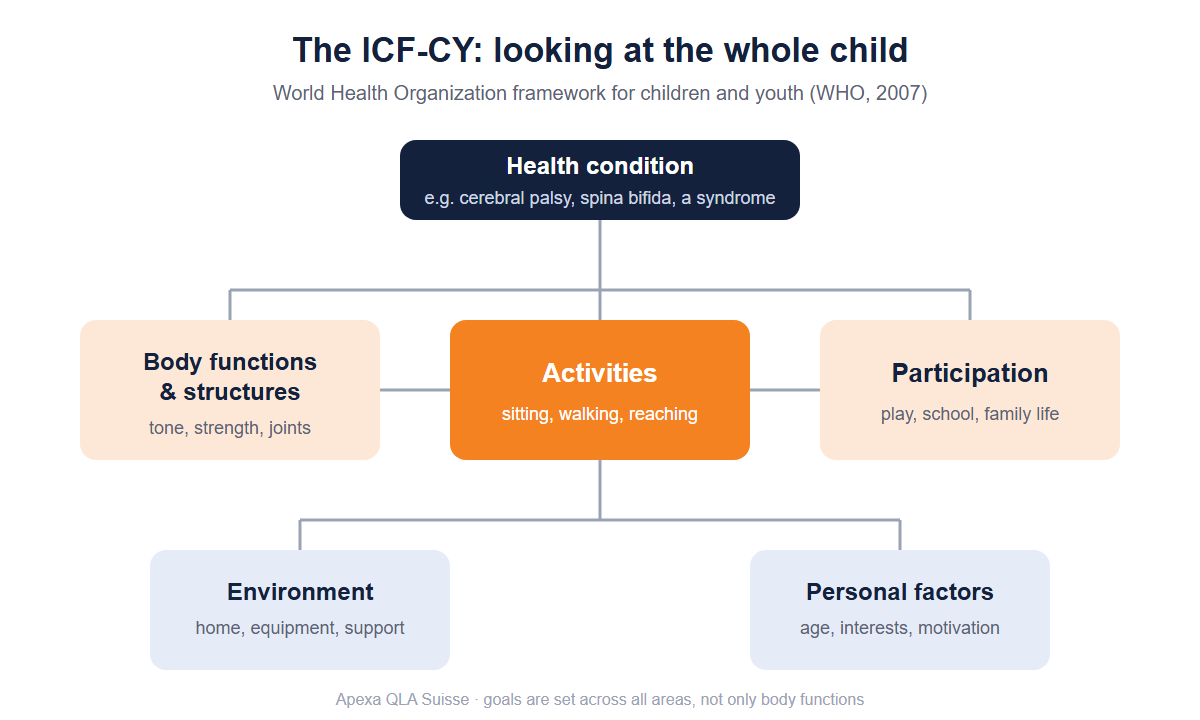
- Goals that matter to your family — set with the ICF-CY, the World Health Organization’s framework that looks at body functions, activities, participation and environment, so goals reach into daily life, nursery and school.
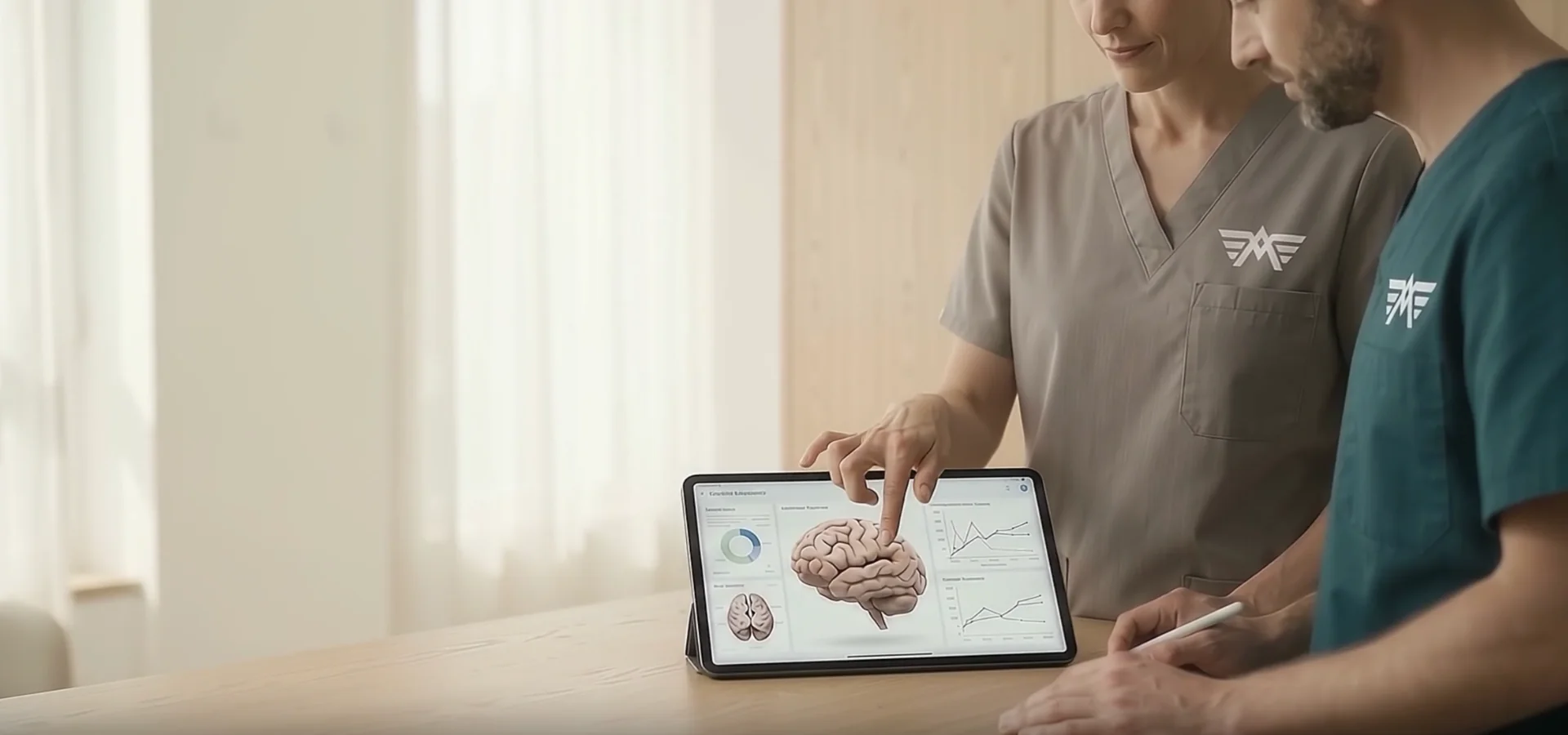
- Video movement analysis — short recordings of how your child moves, analysed frame by frame with software developed by our research partner QLA Labs. You can also upload videos from home through our family portal before you arrive.
- GaitLab gait analysis — for children who walk or are learning to walk, camera-based analysis that measures how the joints move during walking, without markers stuck on the skin.
- Team analysis — every member of our team, the Therapieavengers, looks at your child from their own speciality: suits and suspension, DMI, alignment and TheraTogs, stimulation, breathing. ORCA then brings these views together into one clinical picture.
Step 2: your child’s plan, built from 50-minute units
From the assessment, ORCA builds an architecture of care: which methods, in which order, at what dose. The building block is the therapy unit of 50 minutes, with half units where a shorter, focused session fits better. How many units your child has per day — and which tools fill each unit — is set individually for every child.
- A young child, or a child who tires quickly, may start with fewer units and build up over the block.
- A child with more stamina and a clear goal may work through more units, with real rest between them.
- Units are planned around naps, meals and your child’s best time of day, and adjusted daily as we see how your child responds.
You will never be asked to pick therapies from a menu. That is exactly what ORCA is for.
The tools we combine
ORCA draws on six families of tools. Each unit uses the ones your child needs most at that moment:
- Movement and motor learning — DMI (Dynamic Movement Intervention), CME and Apexi Bounce. DMI uses neuroplasticity — the brain’s ability to form and strengthen connections through active, repeated practice — by asking for responses a child cannot yet make easily.
- Suits and suspension — PediaSuit Protocol, TheraSuit and the Spidercage, for safe upright training with just enough support.
- Stimulation and activation — NISE-Stim, TASES and Galileo vibration, always paired with active movement.
- Wearables and alignment — TheraTogs, Bamboo Braces and Apexi Dynaflex Casting. We are the TheraTogs experts: our certified fitters are recognised worldwide and were trained by the inventor of TheraTogs, Beverly (Billy) Cusick.
- Respiratory therapy — ORCA-Flow, built on RTA (thoraco-abdominal rebalancing).
- Assessment and tracking — GMFM, Peabody-3, ICF-CY, video and gait analysis, and the ORCA report.
What a typical day looks like
Mornings open gently with a play-led warm-up — light activation, or a few minutes on a Galileo plate — before the active units begin. Across the day your child moves through suit and suspension work, motor-learning drills and skill practice, broken up with real rest, snacks and a warm lunch for your child and for you. Siblings have a play room, and little ones can nap in a quiet space.
Afternoons fold you in: a therapist coaches you to carry one or two exercises home, so the gains don’t stop when the week does. Every unit is dosed and logged — effort with a number behind it.
“We don’t chase tiredness. We chase the next repetition the child can own — and then we measure it.”
— Lead therapist, Apexa QLAMeasured every day
Small markers — repetitions, how long a position is held, joint angles, milestone steps — are logged daily. If your child is tired, ill or simply having a hard day, the plan changes. If a goal is reached early, the next one starts.
QLA Labs: the diagnostics and research behind ORCA
QLA Labs is our paediatric neuro-motor research partner in Zug. It builds the software side of ORCA and works on new ways to see what traditional assessment misses:
- Software that turns movement into data — video and gait analysis that make small changes visible and comparable from one block to the next.
- Ethics-approved clinical studies — long-term studies that track how children’s motor skills change with intensive rehabilitation.
- Therapy games — neuroinclusive games for browser and mobile, designed to make intensive practice playful and measurable.
Markerless camera-based motion analysis is a fast-developing field. In healthy adults, a deep-learning markerless system measured walking with joint positions and angles close to those of a traditional marker-based laboratory (Kanko et al., 2021). Its use in children with neuro-motor conditions is still being researched — which is exactly why we combine it with established clinical tests rather than replacing them.
Step 3: the ORCA report
At the end of every block you receive a clear, written ORCA report. It is the difference between “they seem stronger” and a baseline you can build the next phase on. It contains:
- the goals we set together and how far each was reached;
- before-and-after results of the standardised tests, such as the GMFM and Peabody-3;
- findings from video and gait analysis where they were used;
- what worked best for your child — the tools, positions and dose;
- your home programme for the weeks ahead;
- recommendations for the next step: weekly therapy, a virtual visit, an ORCA Enablement block or the next intensive.
The report is written so your doctors, therapists at home and insurer can use it, and it is stored in your family portal.
After the block: keeping the progress
What happens at home matters as much as the block itself. Every family leaves with a home programme. Many combine intensives with weekly sessions, virtual visits or an ORCA Enablement block of three to five days, in which we turn parents into confident co-therapists so your family becomes more independent. If you wish, we also act as your child’s medical case manager, coordinating with your doctors and therapists at home.
Your family portal: a direct line to the team
Every family gets access to our family portal at fam.apexaqla.ch — your direct line to the team at all times. In the portal you can speak to your therapists, upload videos of your child at home so we can give feedback, find your child’s reports and progress measurements, see invoices and financial information, read articles about therapy, and much more.
How to prepare — your child, and you
Bring comfortable movement clothes, any orthotics or daily gear, and a short list of what a good day looks like for your child. Protect sleep and downtime; intensive weeks are tiring in the best way. And plan a couple of gentle rest-day activities — the lake, a park, a treat — so a hard week also becomes a good memory. Families travel from all over the world to Zug for modern therapies and the latest advances in paediatric rehabilitation, and our concierge helps with travel and accommodation. Our article on preparing for your first appointment has more tips.
What the research says about intensive rehabilitation
Intensive, active therapy rests on how the developing brain learns. Neuroscience describes principles of experience-dependent plasticity: skills that are used are kept and strengthened, training should be specific to the skill, enough repetition and intensity are needed for lasting change, and what is meaningful to the person is learned best (Kleim & Jones, 2008).
- Intensive, goal-directed practice works. A 2026 randomised clinical trial at four European centres found that 50 hours of intensive therapy over two weeks (HABIT-ILE) improved gross motor function in preschool children with bilateral cerebral palsy by about 5 GMFM-66 points, compared with less than 1 point with usual activities (Araneda et al., 2026).
- International guidelines support the same ingredients. An international clinical practice guideline recommends child- and family-chosen goals, whole-task practice in real-life settings, support that empowers families, and a team approach (Jackman et al., 2022). A large systematic review rated goal-directed, task-specific training and intensive approaches such as constraint-induced movement therapy among the best-supported interventions (Novak et al., 2020).
- Starting early matters. An international guideline on early intervention for children aged 0 to 2 years with or at high risk of cerebral palsy calls for early, CP-specific intervention that harnesses plasticity (Morgan et al., 2021).
The three pillars of evidence-based practice. Good rehabilitation rests on three pillars that work together: the best available research evidence; clinical expertise — experienced therapists who know how to apply that research to one particular child; and the values, goals and preferences of the child and family (Veras et al., 2016). ORCA is built to bring all three together.
Research on each individual method is at a different stage, and we are honest about that. What we can promise is that we measure your child’s progress rather than assume it.
Questions parents often ask
How long is an ORCA Intensive?
One to four weeks. The right length depends on your child’s age, goals, stamina and your family’s situation, and we recommend it after the assessment.
How many hours of therapy are there per day?
Several hours, planned in 50-minute units with half units where they fit better. The number of units is set individually for each child and adjusted day by day.
Is an intensive too tiring for my child?
It is demanding, so we plan it carefully: real breaks between units, play, meals and rest are part of every day, and the dose is adapted to your child — including on difficult days.
What happens in the assessment?
Standardised tests such as the GMFM and Peabody-3, goal-setting with the ICF-CY, video movement analysis, GaitLab gait analysis where relevant, and a team analysis by our therapists. Together they form the starting point of your child’s plan.
What is in the ORCA report?
Your goals and how far they were reached, before-and-after test results, analysis findings, what worked best, a home programme and recommendations for the next step. Doctors and insurers can use it, and it is stored in your family portal.
What is QLA Labs?
Our research partner in Zug. QLA Labs develops the software side of ORCA — including video and gait analysis — runs ethics-approved clinical studies and creates therapy games for intensive practice.
Can parents take part?
Yes — you are part of the plan. You are coached every day so you can continue at home, and our ORCA Enablement blocks go further for families who want to become confident co-therapists.
How often should my child do an intensive?
Many children do one to three blocks a year, with weekly therapy, virtual visits or a home programme in between. We recommend a rhythm after assessment and adapt it as your child grows.
What does an intensive cost, and will insurance pay?
Costs depend on the length and content of the block; current prices are on our costs and fees page. Whether an insurer contributes depends on your country, insurer and policy — our reports support any application.
Do you work with families from abroad?
Yes. Families travel from 16 countries on four continents to Zug. Our concierge helps with travel and accommodation, and virtual visits keep support going between blocks.
Next step: talk to us
If you are wondering whether an ORCA Intensive could help your child, book a free introductory call through our contact page, or read our guide to intensive therapy for cerebral palsy.
References
- Araneda, R., Ebner-Karestinos, D., Paradis, J., et al. (2026). Hand-Arm Bimanual Intensive Therapy Including Lower Extremities in preschoolers with bilateral cerebral palsy: A randomized clinical trial. JAMA Network Open. doi.org/10.1001/jamanetworkopen.2026.43492
- Folio, M. R., & Fewell, R. R. (2023). Peabody Developmental Motor Scales (3rd ed.). Pro-Ed.
- Jackman, M., Sakzewski, L., Morgan, C., et al. (2022). Interventions to improve physical function for children and young people with cerebral palsy: International clinical practice guideline. Developmental Medicine & Child Neurology, 64(5), 536–549. doi.org/10.1111/dmcn.15055
- Kanko, R. M., Laende, E. K., Davis, E. M., Selbie, W. S., & Deluzio, K. J. (2021). Concurrent assessment of gait kinematics using marker-based and markerless motion capture. Journal of Biomechanics, 127, 110665. doi.org/10.1016/j.jbiomech.2021.110665
- Kleim, J. A., & Jones, T. A. (2008). Principles of experience-dependent neural plasticity: Implications for rehabilitation after brain damage. Journal of Speech, Language, and Hearing Research, 51(1), S225–S239. doi.org/10.1044/1092-4388(2008/018)
- Morgan, C., Fetters, L., Adde, L., et al. (2021). Early intervention for children aged 0 to 2 years with or at high risk of cerebral palsy: International clinical practice guideline based on systematic reviews. JAMA Pediatrics, 175(8), 846–858. doi.org/10.1001/jamapediatrics.2021.0878
- Novak, I., Morgan, C., Fahey, M., et al. (2020). State of the evidence traffic lights 2019: Systematic review of interventions for preventing and treating children with cerebral palsy. Current Neurology and Neuroscience Reports, 20, 3. doi.org/10.1007/s11910-020-1022-z
- Russell, D. J., Rosenbaum, P. L., Cadman, D. T., Gowland, C., Hardy, S., & Jarvis, S. (1989). The gross motor function measure: A means to evaluate the effects of physical therapy. Developmental Medicine & Child Neurology, 31(3), 341–352. doi.org/10.1111/j.1469-8749.1989.tb04003.x
- Veras, M., Kairy, D., & Paquet, N. (2016). What is evidence-based physiotherapy? Physiotherapy Canada, 68(2), 95. doi.org/10.3138/ptc.68.2.gee
- World Health Organization. (2007). International Classification of Functioning, Disability and Health: Children and Youth Version (ICF-CY). WHO.
This article is general information and does not replace a medical assessment. Clinical content on this website is reviewed by Fabienne Theler, MSc PT.