English
 Deutsch
 Español
 Français
 Italiano
 Nederlands
 العربية
 中文
 Dansk
 Svenska
 Norsk
 Suomi
 日本語
 Polski
 Português

Parent guides
Down syndrome and movement: how we work with your child — and with you
Low muscle tone, late sitting, late walking — and a child who wants to explore. How we support children with Down syndrome from the first months to school age, why parents are the main therapists, and what a week with us actually looks like.
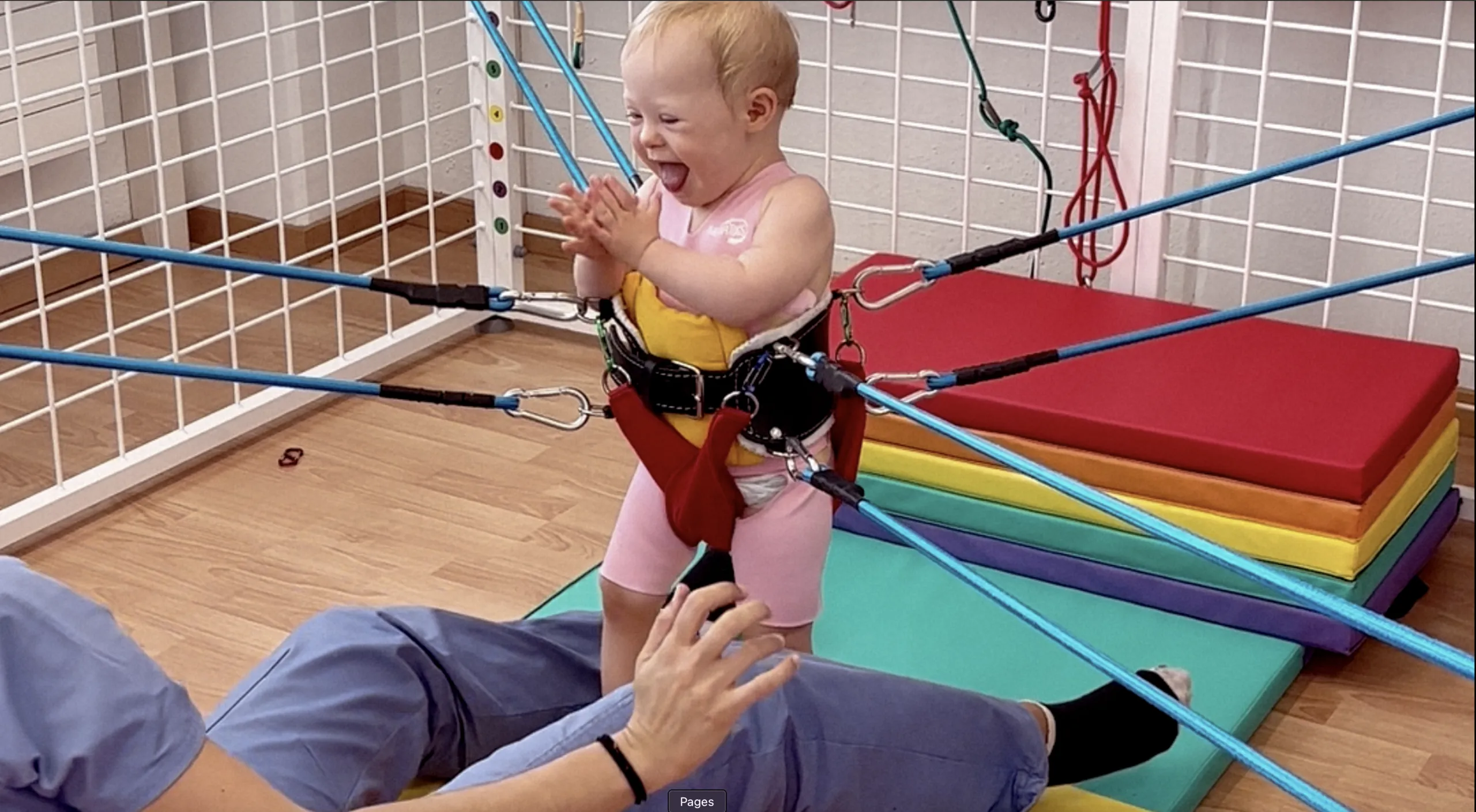
A child first, a diagnosis second
When parents first call us about their baby with Down syndrome, the questions are almost always the same. Will she sit? When will he walk? Is there something we should be doing now?
The honest answer is that every child with Down syndrome is different: in personality, in health, in pace. What most of them share is one very physical starting point: low muscle tone. And that is exactly where we can help, early and actively, together with the family.
This article explains what we do, who we work with, and how a family and our team become one team.
What low muscle tone really means
Low muscle tone (hypotonia) sounds mild. It isn’t. It means muscles have to work harder to hold a position or start a movement. Joints are often more flexible than usual, and balance reactions come later. Sitting costs more energy, standing arrives later, and walking takes longer to become steady.
Studies that followed hundreds of children with Down syndrome show the same picture: motor milestones come, but later and at very different speeds from child to child [1]. Hypotonia does not simply “grow out”. Children build the strength and control that everyday movement depends on through active practice: lots of it, at the right level, repeated in daily life.
You can read more in our guide to genetic syndromes and motor delay and in developmental delays: a parent’s guide.
Who we support
- Babies from the first months, often referred by the paediatrician or the hospital team, when the main goals are head control, rolling and the first sitting.
- Toddlers on the way to standing and walking, and children who are walking but fall a lot, tire quickly or struggle with stairs, running and jumping.
- School-age children who want to keep up in the playground, at sport and in everyday independence.
- Families from Zug and all over Switzerland in weekly therapy, and families from abroad (from across Europe, including the Balkans, and further away) who come to Zug for intensive blocks.
Many of the children we see have additional needs too: heart surgery in the first year, reflux, feeding difficulties, frequent infections [8]. We are used to complex cases, and we plan around the whole child, not around a single milestone.
How we work together
From the first call to the home programme
- Free intro call: you tell us about your child; we explain what is possible and what is not.
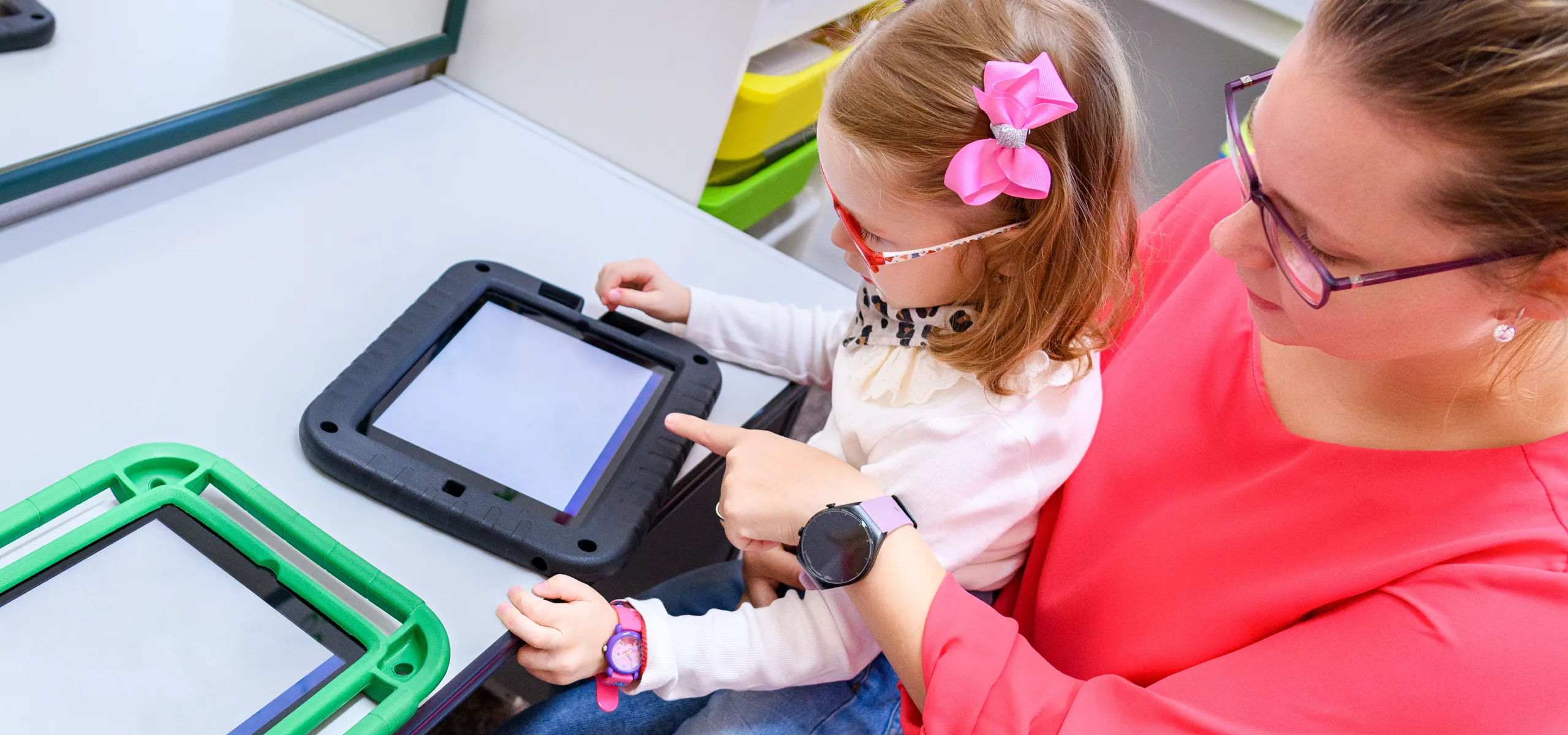
- Assessment we can measure: GMFM and Peabody-3, so progress is seen in numbers, not guessed [2, 3, 4].
- An ORCA plan: clear goals for the next weeks, built with the ORCA Method created by Fabienne Theler, MSc PT.
- Therapy blocks or weekly sessions: active, playful, and at the right intensity.
- A daily home programme: short, realistic exercises that fit into your family's day.
- Re-assessment: we measure again and adjust the plan, instead of repeating what no longer works.
The tools we use — and why
There is no single “Down syndrome therapy”. We choose the tools that fit your child’s goals at this moment, inside the ORCA Method:
- DMI (Dynamic Movement Intervention): an incredible tool and a fundamental part of ORCA. DMI uses precise movement challenges that make the body react, building balance, strength and posture from the very first months. DMI’s own research is still young (case reports and small series), but it builds on well-proven science: the developing brain changes through repeated, active, task-specific practice, which is neuroplasticity [5, 6]. More in our DMI FAQ.
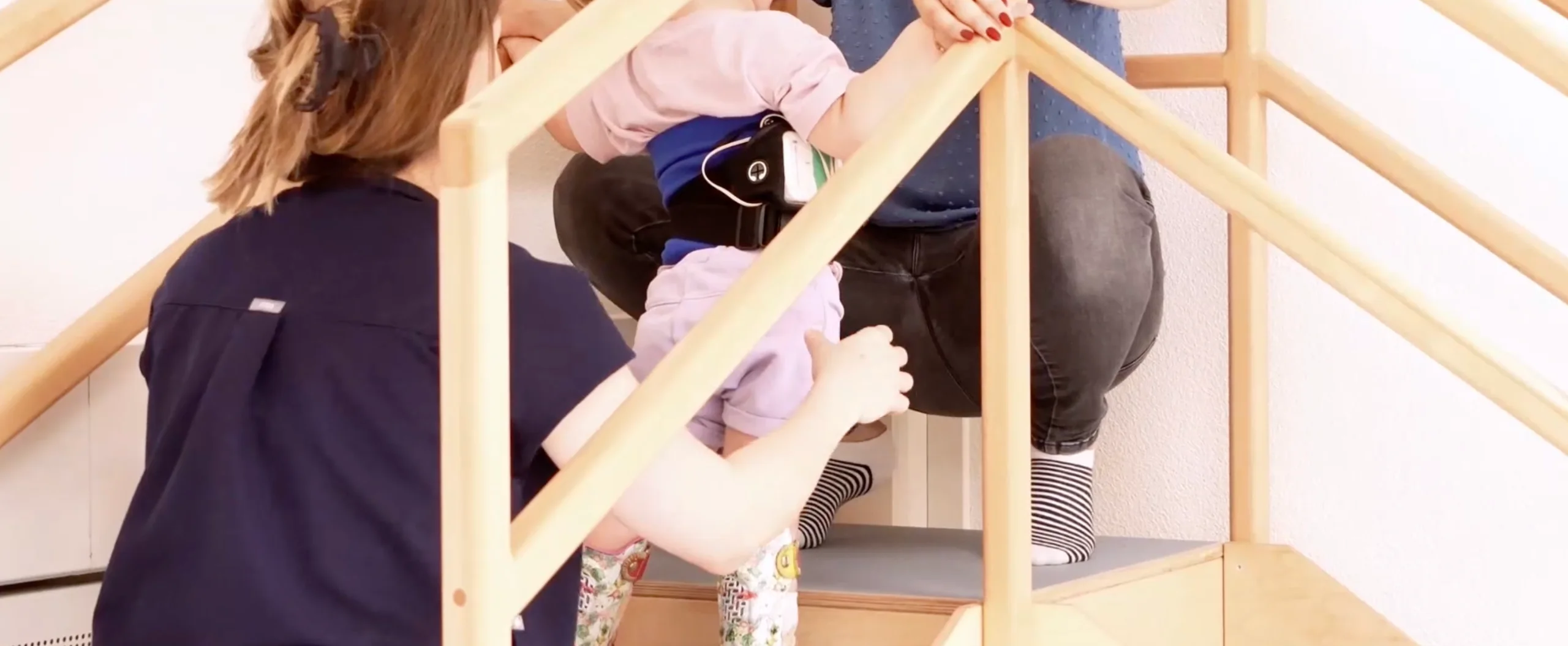
- TheraTogs: a wearable strapping system that gives loose joints and weak trunk muscles the support they need, all day long, while your child moves. We are the TheraTogs experts: certified fitters, recognised worldwide and trained by the inventor, Beverly (Billy) Cusick. See what TheraTogs are and how they are used.
- Galileo: side-alternating vibration training that activates muscles, used from around 6–9 months of age as part of the plan.
- NISE-Stim: gentle electrical stimulation to support targeted muscle activation, which parents learn to continue at home.
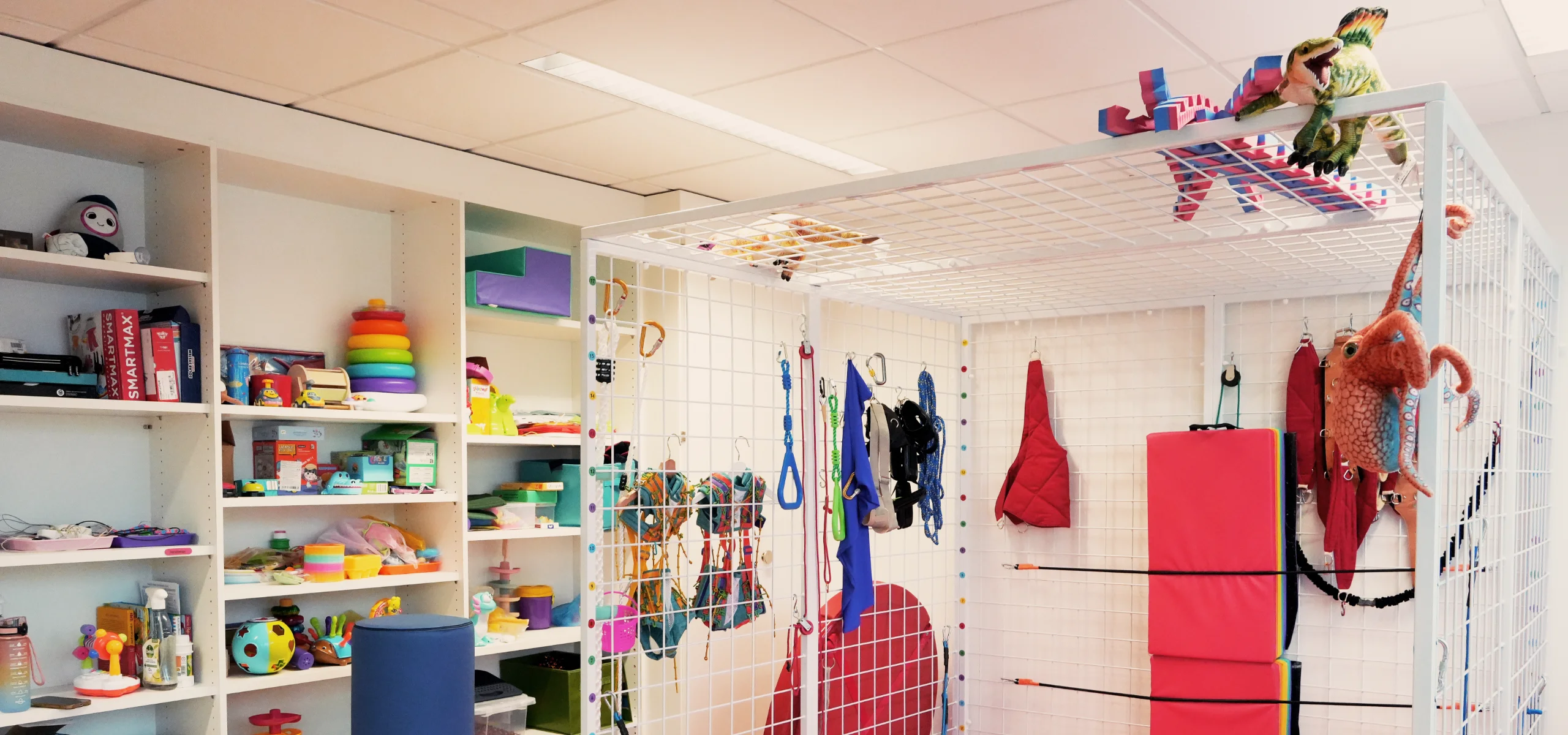
- Walking practice and play in the spider cage, on stairs and outdoors: because walking is learned by walking. Early, structured stepping practice has helped infants with Down syndrome walk sooner in research [7].
You are the main therapist
With Down syndrome, family-centred care matters more than almost anywhere else. A child spends a few hours a week with us, and the rest of the week with you. That is why we work the way the Down syndrome early care page describes: you do most of the practice in everyday life, and we teach, calibrate and check.
In practice, that means:
- we show you the handling and the small daily exercises, and you try them with us until they feel natural;
- ORCA Enablement prepares you to read your child’s signals and adapt the exercises yourself;
- through the family portal, fam.apexaqla.ch, you stay in direct contact with the team between visits: send a short video of a new exercise, find your child’s reports, and ask a question when something changes;
- if you wish, optional medical case management helps coordinate appointments with paediatricians, cardiologists, orthopaedics and school.
We also work closely with your child’s own occupational and speech therapists, because hands, feeding and communication belong to the same picture. Speech and occupational therapy at the centre are planned for the near future. Until then, we coordinate with your local therapists, and for feeding we work with trusted partner therapists. For communication ideas, see our guide to AAC for children.
Four mistakes we help families avoid
- Waiting: low muscle tone does not resolve on its own; the first two years are a wide but time-critical window.
- Once a week only: for many children that dose is simply not enough to change how they move. Short daily practice at home makes the difference.
- Passive instead of active: children learn movement by doing it themselves, with the right support, not by being moved.
- Never measuring again: without re-assessment you cannot tell what works. That is why we use GMFM and Peabody regularly.
Weekly therapy or an intensive?
Both work, and many families combine them. Weekly sessions build steady progress at home in Switzerland. Intensive blocks (several sessions a day over one to three weeks) suit families who travel to Zug, or children who are close to a new step and need a concentrated push. Our 2026 guide to ORCA Intensives answers the questions parents ask before their first block, and Well prepared explains what to bring.
For families in Switzerland, our tips on deducting therapy costs can help, and when school starts, see our practical guide to inclusion at school.
Let's start with a conversation
Every plan starts with listening. Tell us about your child (what she loves, what he finds hard, what you hope for) and we’ll tell you honestly how we can help. Book a free intro call, or read more about who we are and how the centre works.
Sources
- Palisano, R. J., Walter, S. D., Russell, D. J., Rosenbaum, P. L., Gémus, M., Galuppi, B. E., & Cunningham, L. (2001). Gross motor function of children with Down syndrome: creation of motor growth curves. Archives of Physical Medicine and Rehabilitation, 82(4), 494–500. doi.org/10.1053/apmr.2001.21956
- Russell, D., Palisano, R., Walter, S., Rosenbaum, P., Gémus, M., Gowland, C., Galuppi, B., & Lane, M. (1998). Evaluating motor function in children with Down syndrome: validity of the GMFM. Developmental Medicine & Child Neurology, 40(10), 693–701. doi.org/10.1111/j.1469-8749.1998.tb12330.x
- Folio, M. R., & Fewell, R. R. (2023). Peabody Developmental Motor Scales – Third Edition (PDMS-3). Pro-Ed.
- World Health Organization (2001). International Classification of Functioning, Disability and Health (ICF). www.who.int/standards/classifications/international-classification-of-functioning-disability-and-health
- Kleim, J. A., & Jones, T. A. (2008). Principles of experience-dependent neural plasticity: implications for rehabilitation after brain damage. Journal of Speech, Language, and Hearing Research, 51(1), S225–S239. doi.org/10.1044/1092-4388(2008/018)
- Novak, I., Morgan, C., Fahey, M., et al. (2020). State of the evidence traffic lights 2019: systematic review of interventions for preventing and treating children with cerebral palsy. Current Neurology and Neuroscience Reports, 20(2), 3. doi.org/10.1007/s11910-020-1022-z
- Ulrich, D. A., Ulrich, B. D., Angulo-Kinzler, R. M., & Yun, J. (2001). Treadmill training of infants with Down syndrome: evidence-based developmental outcomes. Pediatrics, 108(5), e84. doi.org/10.1542/peds.108.5.e84
- Bull, M. J., Trotter, T., Santoro, S. L., Christensen, C., Grout, R. W., & the Council on Genetics (2022). Health supervision for children and adolescents with Down syndrome. Pediatrics, 149(5), e2022057010. doi.org/10.1542/peds.2022-057010